Wengen
A sunny shelf at 1,274 m reached only by rack railway, with the Jungfrau opposite and the longest downhill race in the world running through it.
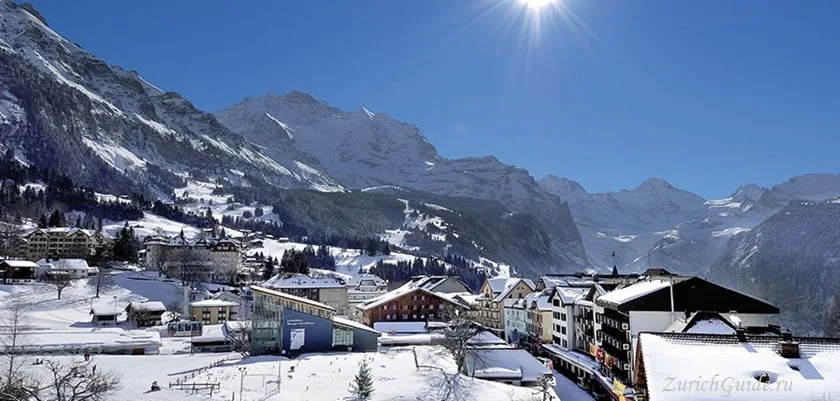
Wengen sits at 1,274 m on the eastern shelf above the Lauterbrunnen valley, facing south-west across it to the cliffs and waterfalls on the other side, with the Jungfrau filling the head of the valley.
There is no road. You arrive by rack railway from Lauterbrunnen in fifteen minutes, and inside the village everything moves by electric cart or on foot.
It has been a resort since the 1890s, largely built by and for the British, who came for the winter and stayed. The village still has a distinctly Edwardian layer under the modern one.
History
Wengen is first recorded in 1268, but it stayed a farming hamlet until British travellers began writing up the surrounding peaks in the early nineteenth century and the village slowly turned into a resort.
Hotel-building took off from the middle of the century. The Launerhaus, one of the larger houses, opened in 1859 with room for around thirty guests; by 1880 the Pension Wengen had beds for a hundred. Until the Wengernalpbahn rack railway went in during the 1890s and made the resort properly accessible, guests still climbed the steep path up from the valley floor on foot.
The clientele was overwhelmingly British, and the village got an Anglican church to go with it. The Downhill Only Club, founded here in 1925, is said to be the oldest downhill ski racing club in the world, and British races were already being held around Wengen in the early 1920s — skiers rode the train up, which served as the region’s first ski lift before the sport had lifts of its own.
Not all of the village is that old: a fair share of it was rebuilt in a plainer style in the 1970s, so the chalets sit alongside more ordinary construction rather than forming a uniform period village.
Wengen or Mürren?
The two car-free shelves face each other across the valley and the choice between them is the standard question.
Wengen is larger, sunnier, has more hotels and shops, and is on the direct railway to Kleine Scheidegg and the Jungfraujoch.
Mürren is smaller, quieter, higher, and has the better view — from there the Eiger, Mönch and Jungfrau line up in a row rather than at an angle.
Neither is wrong. Wengen for convenience, Mürren for stillness.
Männlichen
The cable car from Wengen climbs to Männlichen at 2,222 m in five minutes, and from the top runs the best easy walk in the Bernese Oberland: the Panoramaweg to Kleine Scheidegg, about an hour and a quarter, almost level, with the Eiger north face, the Mönch and the Jungfrau directly in front of you the entire way.
Anyone can do it. If you have one afternoon in this region and clear weather, this is what to do with it.
The Lauberhorn
Wengen hosts the Lauberhornrennen in January — the longest downhill race in the World Cup at about 4.5 km, taking two and a half minutes where most take under two, with jumps that have entered ski folklore.
It has run since 1930 and it fills the village and every train up the valley. Come for it deliberately or avoid the weekend entirely.
Skiing and walking
The ski area links Wengen with Grindelwald over Kleine Scheidegg and Männlichen — a large, mostly intermediate area with the scenery doing a lot of the work.
In summer the paths run in every direction from the lifts, and the descent on foot back down to Lauterbrunnen takes about two hours through pasture and forest.
Practical
- Getting there by train normally means changing at Bern, Interlaken Ost and Lauterbrunnen — three or four changes and around three hours from Zurich, Geneva or Basel airport.
- Cars stay in Lauterbrunnen, where there is a multi-storey car park by the station.
- Luggage can be sent ahead station to station; see getting around.
- Regional passes — the Jungfrau and Berner Oberland passes cover these lifts properly, where a national pass only discounts them. See tickets and passes.
- The last train down is early. Check it on arrival.
When to go
June to September for walking, late December to March for skiing. The shelf gets sun when the valley floor below is still in shadow, which is exactly why the village was built up here rather than down there.
Weather in Wengen month by month
| Month | Day | Night | Rainfall |
|---|---|---|---|
| January | 0° | -8° | 79 mm |
| February | +1° | -8° | 69 mm |
| March | +4° | -4° | 83 mm |
| April | +8° | 0° | 105 mm |
| May | +14° | +5° | 144 mm |
| June | +18° | +9° | 149 mm |
| July | +20° | +11° | 143 mm |
| August | +20° | +11° | 149 mm |
| September | +16° | +7° | 117 mm |
| October | +12° | +4° | 110 mm |
| November | +5° | -2° | 111 mm |
| December | +1° | -6° | 93 mm |
Averages for 1991–2020, computed from NASA POWER daily data and corrected for the elevation of the place (1276 m). Day and night are the average daily high and low, not records; rainfall is approximate. Current conditions from the Norwegian Meteorological Institute, CC BY 4.0.
Updated: