Tarasp and the Lower Engadin
A white castle on a rock, villages covered in scratched plaster patterns, twenty mineral springs, and the only national park in Switzerland.
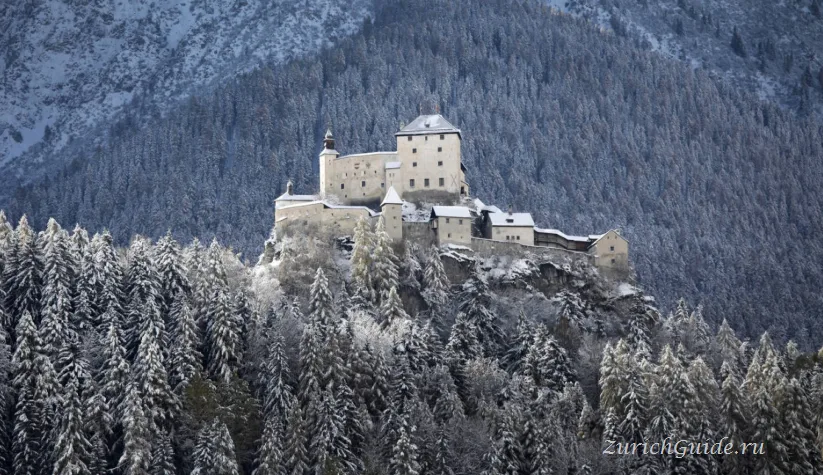
Tarasp is a white castle standing on a rock above the Inn valley in the Lower Engadin, in the far east of Switzerland, and it is the emblem of one of the country’s least-visited and most distinctive corners.
This is Romansh country — the fourth national language, descended directly from the Latin of the Roman province, spoken by a few tens of thousands of people and nowhere more so than in these valleys.
The village
Tarasp is not one settlement but around a dozen hamlets scattered across a plateau above the Inn — the only village of the Lower Engadin on the river’s south bank. Its centre is the small square of Fontana. In 2015 Tarasp merged into the municipality of Scuol along with four neighbouring villages, forming one of the largest municipalities in Switzerland by area. Sparsels, roughly halfway up to the castle, is the most attractive of the hamlets, with a hotel built in the Engadin style.
Two buildings here are listed as Swiss heritage sites of national significance: the castle, and the Trinkhalle, a pump room built over one of the valley’s mineral springs.
The castle
Built in the eleventh century, held by Austria for four hundred years, and bought in 1900 by a German mouthwash manufacturer named Karl Lingner, who restored it thoroughly and installed an organ.
The castle stands on a rock about 100 metres above the valley, with a small lake at its foot reflecting the walls. It is first recorded in a document of 1040; the lords of Tarasp are said to have built their residence here earlier in the same century, after moving from the region of Lake Como. In 1239 it passed to the Counts of Tyrol, and because the whole of the Lower Engadin belonged to the diocese of Chur, control of the castle was fought over for generations by the Counts of Tyrol, the lords of Graubünden and the bishops of Chur. From 1464 Tarasp was an Austrian county — the walls still carry the imperial eagle and the inscription “Hie Estereih” (“Here, Austria”) — and in the early sixteenth century the complex was enlarged to its present size and converted into a fortress.
Napoleon attached Tarasp to the Helvetic Republic in 1803. The young canton of Graubünden had neither the money nor the use for a decaying castle, and in 1829 it was sold into private hands, to a buyer from Scuol, for under 500 francs. Over the following decades it changed hands repeatedly and was stripped out: furniture and wall panelling were sold off at art markets, and timber from its galleries and wooden porticoes was cut up and burned as firewood by locals. By around 1900 it stood empty and was falling into ruin.
Karl Lingner came to Tarasp for a cure in the summer of 1900, was appalled by the state of the castle, and bought the whole complex for 20,000 francs. He hired Rudolf Rahn, then considered the leading authority on castles, as his restoration adviser, and bought period panelling and furniture from old aristocratic houses across Graubünden and neighbouring Tyrol to refit the rooms. In the former armoury he built a large organ, made by the Dresden workshop Jehmlich, which the same firm restored in 1934 and which is still played at summer concerts in the castle. He also planted more than a thousand trees around the castle and the lake and laid out drives through the grounds — motoring was banned in Graubünden until 1925, so Lingner had his own car brought by horse-drawn cart from the cantonal border to Tarasp, where he could drive it on his own land.
Lingner never lived to see the castle finished: he died suddenly on 5 June 1916. He left it to Friedrich August III, the last king of Saxony, who declined the inheritance; it passed instead to his friend Ernest Louis, Grand Duke of Hesse, whose family looked after it for decades — his son Louis and Louis’s wife, Princess Margaret, in particular. After Margaret’s death it passed to Moritz, Landgrave of Hesse, and his children.
Since 2016 it has belonged to the artist Not Vital, who opened it to visitors and installed contemporary art in the rooms — which is either the making of the place or an imposition on it, depending on who you ask locally.
Guided tours run in season; the castle is visible from the whole valley and is worth the drive up even if it is shut.
The church
Tarasp remained Catholic while the rest of the valley turned Protestant during the Reformation, and its small church is decorated more richly than the Protestant churches nearby as a result. It was built in 1567; the present tower and the sacristy, once the choir, survive from that building, and the rest was rebuilt in 1674–78. The altar carries a Baroque painting and decoration from 1678, with two side altars added in 1743.
The sgraffito villages
The reason to spend a day here rather than an hour.
Engadin houses are built thick-walled against the winter, with deep funnel-shaped window recesses, and decorated with sgraffito — patterns scratched through white lime plaster to a darker layer beneath. Rosettes, scrolls, dates, mottoes in Romansh across the fronts.
Guarda is the best of them and is a protected site; Ardez, Ftan and Sent are close behind. All are on the same short stretch of valley, all reachable by post bus, and none takes more than an hour to walk round.
Scuol and the water
Scuol, the main village, sits on around twenty mineral springs, and the water has been drunk and bathed in since the sixteenth century. Several public fountains in the village run mineral water you can taste — each with a different mineral content, and most of them frankly unpleasant, which was taken as evidence they worked.
Bogn Engiadina is the modern bath complex, with an Irish-Roman circuit done over about two hours; see thermal baths.
The National Park
Half an hour up the valley is the Swiss National Park, founded in 1914 and the oldest in the Alps. It is also the strictest: nothing is managed, nothing is planted, nothing is culled, and visitors must stay on the marked paths. No dogs, no camping, no leaving the trail at all.
The result is genuinely wild forest and high pasture with red deer, ibex, chamois, marmots and bearded vultures, reintroduced here in the 1990s. The visitor centre at Zernez explains the rules and lends binoculars.
Getting there
- By train — Zurich about three and a half hours via Chur and the Vereina tunnel, or over the Albula. This is the far end of the country and the journey is long by Swiss standards.
- The Bernina Express and Glacier Express both run through Graubünden, and St. Moritz is an hour and a half up the Engadin.
- By post bus between the villages, on the ordinary ticket.
When to go
June to October for walking and the park, which is open roughly June to November and closed by snow the rest of the year.
Winter for cross-country skiing — the Engadin has the best network in Switzerland, and the Engadin Ski Marathon in March draws 13,000 people.
The valley is high, dry and sunny, and it has the largest temperature swings in Switzerland: hot afternoons and cold nights, even in summer.
Weather in Tarasp and the Lower Engadin month by month
| Month | Day | Night | Rainfall |
|---|---|---|---|
| January | -1° | -9° | 38 mm |
| February | +2° | -8° | 27 mm |
| March | +8° | -4° | 34 mm |
| April | +12° | -1° | 35 mm |
| May | +16° | +4° | 53 mm |
| June | +20° | +7° | 80 mm |
| July | +22° | +9° | 88 mm |
| August | +22° | +9° | 109 mm |
| September | +17° | +5° | 65 mm |
| October | +12° | +1° | 69 mm |
| November | +5° | -4° | 63 mm |
| December | -1° | -8° | 47 mm |
Normals for 1991–2020 from MeteoSwiss, station Scuol, open data, version of 29 July 2026. Adjusted to the elevation of the place. Day and night are the average daily high and low, not records; rainfall is approximate. Current conditions from the Norwegian Meteorological Institute, CC BY 4.0.
Updated: