Stein am Rhein
A market square painted end to end with sixteenth-century frescoes, and the best-looking small town in Switzerland.
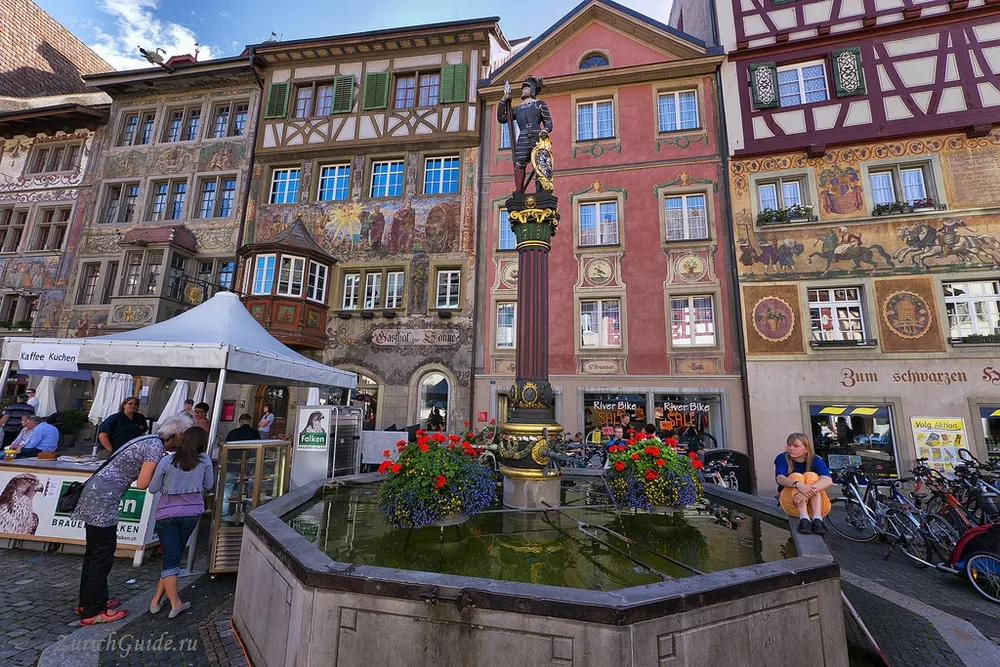
Stein am Rhein is very small — about 3,400 people — and it has the most completely painted town square in Switzerland.
The houses on the Rathausplatz and along Understadt are covered in frescoes from the sixteenth and seventeenth centuries: biblical scenes, allegories, classical stories, run end to end across the fronts, with carved oriel windows projecting between them. Each house is named for its painting — the White Eagle, the Red Ox, the Sun.
It sits where the Rhine leaves Lake Constance, which is why it was worth building here in the first place: this was the crossing point, and the town taxed it.
The old town itself is not much more than one street — Understadt running into Oberstadt — about 500 metres long and narrower still, with an ordinary Swiss village around it once you are past the old gates. It is at its best at Christmas, when the street is strung with lights and a tree goes up outside the town hall.
History
A religious community here goes back to the Roman period; it grew into the abbey of St. Georgen, substantially rebuilt between the fifteenth and early sixteenth centuries, and did as much as the river crossing to build the town around it. After the Reformation the monastery was dissolved and its church became a parish church; the rest of the complex is now the museum described below.
The town hall on the Rathausplatz, built in the sixteenth century, served for a long time as a trading house. Its council chamber is now a small museum of civic documents, old weapons and armour, and the town’s coats of arms.
Stein am Rhein sits barely a kilometre from the German border, and on 22 February 1945 American bombers aiming for a target across it hit the town instead, badly damaging the Untertor, the lower gate in the old town wall. It was rebuilt after the war.
What to see
The square is the point, and seeing it takes half an hour. Then:
Along the Rathausplatz and Understadt, each house is known by name and by what is painted on it. Zum Hirschen (“the Stag”) and its neighbour Vordere Krone (“the Crown”) carry modestly painted wooden oriels, both put up after the so-called oriel dispute of 1707; Vordere Krone is first recorded in 1398 and keeps a Renaissance interior behind a facade repainted in 1734. Zum Roten Ochsen (“the Red Ox”), said to be the town’s oldest tavern, has traded since 1466; its oriel and biblical frescoes were added in 1615. Gasthof zur Sonne, reckoned the oldest inn in Stein am Rhein, got its wall painting in 1900 — a scene of Diogenes meeting Alexander the Great — above a lavish interior of blind arcades and rococo decoration. Zum Weissen Adler (“the White Eagle”), next to the town hall, carries the oldest frescoes in town, painted in the 1520s, probably by Thomas Schmid, in an early-Renaissance style, though the house itself is first recorded in 1418. Zum schwarzen Horn (“the Black Horn”), a five-storey corner house with a half-timbered upper floor and an oriel finished in 1515, is said to be the birthplace of Johann Rudolf Schmid, later Baron von Schwarzenhorn and imperial ambassador to the Ottoman sultan in the 1630s and 1640s. The 1707 dispute that gave Zum Hirschen and Vordere Krone their oriels started next door at Zum Raben (“the Raven”), whose owner built one without permission.
Museum zum Lindwurm, on Understadt, recreates nineteenth-century bourgeois and rural life in a furnished town house you walk through floor by floor, from the cellar and wash-house up to the belle-étage. It keeps seasonal hours and is shut through the winter.
Kloster St. Georgen, the Benedictine monastery by the river, dissolved at the Reformation and left largely untouched since — which makes its late-medieval interiors, painted halls and cloister unusually intact. It is now a museum.
Inside, look for the Gothic gallery and the cycle of frescoes in the so-called festival hall, among the earliest Renaissance work in northern Switzerland, and for the small drainage spouts on the tower, carved as crowned dragons. The church itself, by contrast, is bare.
Burg Hohenklingen, the castle on the hill above, twenty minutes’ walk up through vineyards, with a restaurant and the view over the town, the river and into Germany.
The castle dates from around 1200 and has recently been fully restored. From the top the view takes in the Hegau hills to the south as well as the lake and the river; there is a car park close by for anyone who would rather not make the climb on foot.
Understadt and Oberstadt, the two streets running off the square, which have the frescoes without the crowds.
The old gates and towers mark the ends of the walled town. Untertor, the lower gate mentioned above, dates from 1367; its clock mechanism was renewed in 1908. Obertor, the upper gate to the north, is first recorded in 1363, when farmers and vine-growers used it to reach the fields outside the wall, and carries the town’s coat of arms on its outer face. Hexenturm — the “witches’ tower” — is the easternmost point of the wall, built in the fourteenth century as both the city prison and the eastern gate onto the riverbank; its battlements were later filled in as windows and given a roof. Chretzeturm, a three-quarter-round twelfth-century defence tower, gained its gabled roof and the house built against it in the fifteenth century, and has held studios and flats for visiting artists since 1999. The Zeughaus, the old arsenal, has a late-Gothic staircase and doors that narrow floor by floor, built for hoisting goods; besides storing weapons it has served as a place of worship, a meeting hall, a grain store and a fire station.
Werd island and Wagenhausen, a short way downstream where the Rhine leaves Lake Constance, make a good half-day out from town. This tiny island in the river has a long history: Franciscan friars watched over its chapel, the Otmarskapelle, for about fifty years, and its bell, cast in 1291, is said to be one of the oldest still working in Switzerland. Nearby, the priory of Wagenhausen has its own tangled story — after the Reformation reached the area from Hirsau, near Calw in Germany, the priory found itself caught up in the disputes that followed.
Getting there
- By train — Zurich about an hour with a change, or 20 minutes from Schaffhausen.
- The two routes — one changes at Schaffhausen onto a local train toward Stein am Rhein, the other changes at Winterthur onto a different local line. Both take a bit over an hour from Zurich, door to door.
- By boat — the better way. Boats run from Schaffhausen down the Rhine in about an hour and a half, and from Konstanz on Lake Constance. Rail passes cover them.
- The classic day out of Zurich: the Rhine Falls in the morning, boat or train to Stein am Rhein for lunch, back by evening.
Timing
It is a small town on every coach itinerary in the region, and between eleven and three in summer the square is full. Come early or stay late. An hour after the last coach leaves it is a different place entirely.
December is the other argument: a lit tree in the middle of the painted square, and a Christmas market around it, which is the image everyone has of Switzerland at Christmas and is for once accurate.
Stein am Rhein is third on the list of the ten most beautiful towns.
Where to park in Stein am Rhein
| Car park | Spaces | Fee | From centre |
|---|---|---|---|
| Öhningertor | 3 | paidmax 2 h | 120 m |
| Fischmarkt | — | paidmax 2 h | 120 m |
| Chlosterhof | — | paidmax 2 h | 160 m |
| Neumüli | 36 | paid | 210 m |
| Chlosterwis | — | paid | 310 m |
| Knecht Optik | — | — | 350 m |
| Uf Burg | — | — | 380 m |
| Bahnhof | 39 | paid | 530 m |
8 more are mapped nearby — see them on OpenStreetMap.
Data © OpenStreetMap contributors, ODbL licence, snapshot of 22 August 2026. The map is drawn by volunteers: the list is not complete, and a dash means “not recorded” — not “free” and not “no spaces”. This is not an official parking directory: when you get there, read the signs and the machine at the entrance.
Weather in Stein am Rhein month by month
| Month | Day | Night | Rainfall |
|---|---|---|---|
| January | +4° | -2° | 83 mm |
| February | +5° | -2° | 74 mm |
| March | +10° | +1° | 87 mm |
| April | +14° | +5° | 89 mm |
| May | +19° | +9° | 135 mm |
| June | +22° | +13° | 137 mm |
| July | +24° | +15° | 140 mm |
| August | +24° | +15° | 135 mm |
| September | +20° | +11° | 105 mm |
| October | +15° | +7° | 96 mm |
| November | +9° | +2° | 91 mm |
| December | +4° | -2° | 101 mm |
Averages for 1991–2020, computed from NASA POWER daily data and corrected for the elevation of the place (407 m). Day and night are the average daily high and low, not records; rainfall is approximate. Current conditions from the Norwegian Meteorological Institute, CC BY 4.0.
Updated: