St. Gallen
A baroque library that is one of the most beautiful rooms in the world, in a town that once made the lace for half of Europe.
St. Gallen is in the north-east, an hour from Zurich, and it has one thing that would justify a much longer journey.
History
St. Gallen is the capital of the canton of the same name and the largest town in German-speaking Eastern Switzerland — one of the higher-set towns in the country, at around 700 metres, and fairly large by Swiss standards, with a population above 70,000.
The story starts with an Irish monk: Gallus settled as a hermit beside the river Steinach in 612. About a century after his death an abbey was built on the site of his cell and named after him. In 954 the settlement was walled for protection against Saracen raiders, and the town grew up around those walls under the abbey’s authority. It became a free imperial city in 1311; forty years later the guilds, led by the weavers, took control of civic government, and in 1415 they bought the town’s independence outright from the German king Sigismund. By the mid-fifteenth century St. Gallen had joined the Swiss Confederation.
Napoleon’s invasion stripped both the town and the abbey of their authority. They were merged with the neighbouring Appenzell region into a single canton under the short-lived Helvetic Republic; when that republic collapsed under opposition from across Switzerland in 1803, St. Gallen became capital of a separate, Protestant canton of the same name, and the Catholic monks were driven out of the abbey.
The abbey library
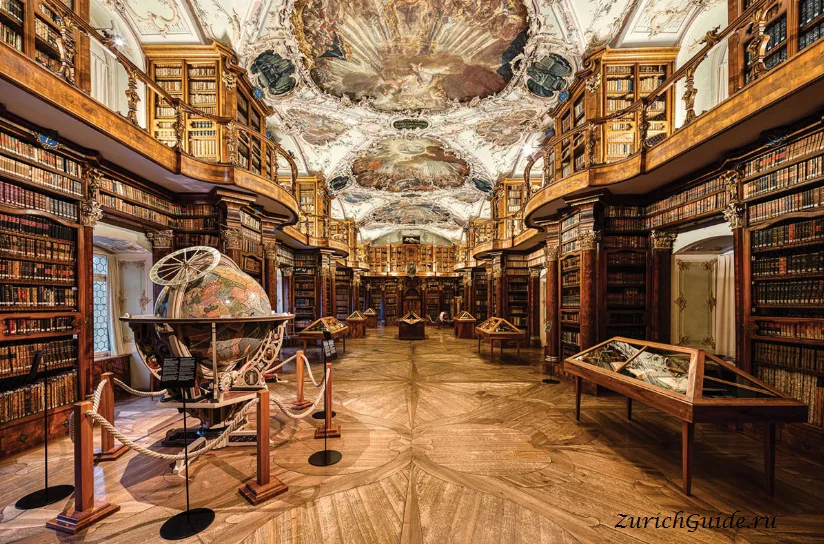
The Stiftsbibliothek is the oldest library in Switzerland and one of the most beautiful rooms anywhere: a rococo hall of 1767, all inlaid walnut, carved galleries and a painted ceiling, holding around 160,000 volumes including some 2,100 manuscripts, of which several hundred are more than a thousand years old.
Among them is the Plan of St. Gall, a ninth-century architectural drawing of an ideal monastery — the oldest surviving building plan in Europe, and the only one from the Carolingian period.
You put on felt overshoes to walk on the parquet. Photography is not allowed inside, which is why the room is worth seeing rather than looking up.
The abbey precinct, including the baroque cathedral next door, is a UNESCO World Heritage site. The monastery was founded around the hermitage of an Irish monk, Gallus, in the seventh century, and for three hundred years it was one of the principal centres of learning in Europe.
The abbey building itself, marked by its twin towers, comes a close second to the library for decoration, with dark green frescoes across its ceilings and heavy stuccowork throughout. A stretch of old wall survives in the north-east corner of the precinct — a leftover from the years when the town was physically divided between its Catholic and Protestant halves.
The embroidery city
The other half of St. Gallen’s story. From the nineteenth century the town dominated the world trade in machine embroidery and lace — at its height around 1910 it accounted for a fifth of Swiss exports, and the wealth built the ornate merchant houses in the centre.
The trade collapsed after the First World War and has never returned at that scale, but St. Gallen textiles are still used by Paris and Milan couture houses. The Textilmuseum holds the archive and is far more interesting than the subject sounds.
St. Gallen’s success went back further than 1910: the town had specialised in textiles since the fifteenth century, and the first embroidery machines were built here in the early nineteenth. For decades much of the work was done in farmhouses rather than factories — a machine installed at home let farmers and craftsmen earn through the winter, between spells of weaving or spinning, while merchants who supplied the thread and sold the finished lace abroad grew rich on the arrangement. The number of machines in the region roughly tripled between 1872 and 1890, from around 6,400 to over 19,000, and over that same stretch the share of them sitting in factories, rather than farmhouses, fell from 93% to 53% as the home-based trade overtook it.
The Stickereibörse
The old Embroidery Exchange building, headquarters of the Swiss Union Bank when it went up in 1889–91, is a lavishly decorated baroque banking palace with a knowing joke on its roofline: a bronze statue of Hermes, the Greek god of merchants, travellers and thieves, looking down over the old town. Foreign trade delegations came here to choose embroidery samples and place orders — a market where manufacturers, merchants, agents and embroiderers all did business under one roof.
The oriels
The old town has around 110 painted and carved oriel windows — projecting bay windows on the merchant houses, each one a display of what the owner could afford. The most famous is the Pfalzkeller camel oriel on Gallusstrasse.
The heaviest concentration is on Gallusplatz, Spisergasse, Schmiedgasse and Kugelgasse, where the merchant houses stand shoulder to shoulder. The tourist office runs guided walks that point out the details on individual windows.
The university
The University of St. Gallen — HSG — was founded in 1898 as the Academy of Commerce and has grown into one of the most respected schools of business, economics and law in the German-speaking world.
The red square
The Stadtlounge — a public space in the banking district covered entirely in red rubber: the ground, the benches, the tables, a car, all poured in the same soft red surface, designed by Pipilotti Rist and Carlos Martinez in 2005.
It is either delightful or absurd, and it is certainly unlike anything else in Switzerland.
White spheres float above the red, tethered clear of the ground below, next to the Raiffeisen bank building the square serves — the whole effect has been likened to Salvador Dalí.
Also in the old town
- Karlstor — a city gate from 1570, once part of the defensive wall. Legend has it that the first person to ride through was St Charles Borromeo, who gave it his name; a relief of the crucifixion sits above the arch, with St Gallus and Abbot Otmar carved beneath.
- Kirche St. Laurenzen — the Protestant parish church, first built around the middle of the twelfth century. For close to three hundred years it was the political, religious and social centre of the city republic, and it remains a meeting point for St. Gallen today.
- Waaghaus — the old weigh house, built in 1584–85 for weighing, declaring and storing goods brought to market. It now hosts markets and exhibitions, with the city parliament’s chamber on its upper floor.
- Volksbad — opened in 1906 as only the second public indoor swimming bath in Switzerland, 42 years after the one in Winterthur, which has since closed; the oldest to survive anywhere in the country.
- Wegelin — founded in 1741, with client assets of around CHF 24 billion at its peak, it was the oldest bank in Switzerland until it collapsed in 2012.
Getting there
- By train — Zurich about an hour, direct and frequent. Winterthur 35 minutes.
- On foot — the abbey and old town are five minutes from the station.
- From elsewhere in Switzerland — direct trains also run from Basel, Lucerne, Schaffhausen, Chur, Lausanne and Geneva Airport, most of them routed through Zurich.
Nearby
- Appenzell — half an hour by narrow-gauge railway, and the most traditional canton in Switzerland; see the ten most beautiful towns
- Säntis — the mountain that dominates the region, 2,502 m, with a cable car and a view claimed to reach six countries
- Lake Constance — twenty minutes down to Rorschach, and boats from there
- Appenzeller Schaukäserei at Stein — see cheese dairies
When to go
Any time — the library is indoors and open all year, though it closes for a fortnight in November for the annual inventory. Check before travelling specifically for it.
The Olma, the Swiss agricultural fair, fills the town for ten days in October and is a genuine spectacle, including a race in which people run alongside pigs.
Where to park in St. Gallen
| Car park | Spaces | Fee | From centre |
|---|---|---|---|
| Cityparking Burggraben underground | 250 | paid | 190 m |
| Grabenhalle | 20 | paid | 240 m |
| Cityparking Brühltor (44) underground | — | paid | 300 m |
| Parkhaus 43 Spisertor underground | — | paid | 330 m |
| Manor multi-storey | 137 | paid | 340 m |
| Parkhaus Oberer Graben underground | — | paid | 370 m |
| Parkhaus Rathaus St.Gallen underground | — | paid | 410 m |
| Gartenstrasse underground | — | paid | 430 m |
14 more are mapped nearby — see them on OpenStreetMap.
Data © OpenStreetMap contributors, ODbL licence, snapshot of 22 August 2026. The map is drawn by volunteers: the list is not complete, and a dash means “not recorded” — not “free” and not “no spaces”. This is not an official parking directory: when you get there, read the signs and the machine at the entrance.
Weather in St. Gallen month by month
| Month | Day | Night | Rainfall |
|---|---|---|---|
| January | +4° | -2° | 67 mm |
| February | +5° | -1° | 64 mm |
| March | +9° | +2° | 87 mm |
| April | +13° | +5° | 103 mm |
| May | +17° | +9° | 156 mm |
| June | +21° | +13° | 170 mm |
| July | +22° | +14° | 174 mm |
| August | +22° | +14° | 185 mm |
| September | +18° | +11° | 138 mm |
| October | +13° | +7° | 105 mm |
| November | +8° | +2° | 93 mm |
| December | +5° | -1° | 90 mm |
Normals for 1991–2020 from MeteoSwiss, station St. Gallen, open data, version of 29 July 2026. Adjusted to the elevation of the place. Day and night are the average daily high and low, not records; rainfall is approximate. Current conditions from the Norwegian Meteorological Institute, CC BY 4.0.
Updated: