Spiez
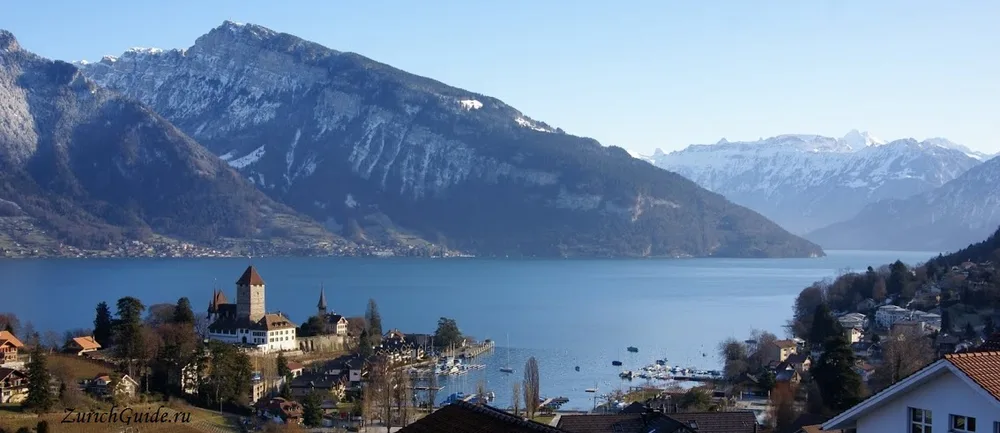
A medieval castle on a spit of land in a perfect crescent bay, with vineyards behind it and the Bernese Alps across the water.
Spiez occupies a crescent bay on the south shore of Lake Thun, with a castle standing on the point that closes it. It is the view from the train window that makes people get off, and the station is high above the town so you see the whole arrangement at once.
Away from the castle, Spiez has no old town to speak of — the slopes around it are houses and gardens rather than a historic quarter, and the castle is the only old building. The setting is why the town is worth the stop, and it sits naturally on a route around the other towns on Lake Thun and Lake Brienz.
The castle
Schloss Spiez was begun in the eleventh century and grew over the next six hundred years, so it reads as a keep with a country house attached. It belonged to the von Bubenberg family and then to the von Erlachs, and it has been a museum since 1929 — the rooms are furnished by period, and the tower gives the bay.
Portraits of the Bubenberg and Erlach families who owned the castle hang in the rooms, and the tower stair passes wall paintings from the thirteenth century on the way up.
Beside it stands the Romanesque church, from about 1000, one of the oldest in Switzerland, with faded medieval frescoes in the apse. It is small, dark and worth the five minutes.
Next to the castle is the Heimat- und Rebbaumuseum, a small museum of local history and winemaking.
The bay and the vineyards
The slope behind the castle is planted with vines — this is one of the highest wine regions in Switzerland and the northernmost of any consequence, making mostly Riesling-Sylvaner and Pinot Noir. A marked path runs through them, and the vintners open their cellars on some weekends.
The bay itself has a small harbour and a lakeside bathing area, and the water in the shallow crescent warms up faster than the open lake.
In September the grape harvest is marked by the Läser-Fescht, a wine festival.
Boats and the Niesen
Spiez is a stop on the Lake Thun boat services — see the lakes — which makes it easy to combine with Thun at one end and Interlaken at the other, and with Oberhofen castle across the water.
Schloss Oberhofen passed from Habsburg to Bernese control after the battle of Sempach in 1386 and remained a Bernese property into the nineteenth century; the grounds hold a richly decorated medieval chapel and a garden with a children’s playhouse. Nearby, at Wichterheer, the Sammlung im Obersteg gallery holds a collection of modern art said to include work by Picasso and Chagall. Further round the shore, at Hilterfingen, Schloss Hünegg shows a different century: its rooms are dressed in brocade and carpet in a mix of neo-Renaissance and Art Nouveau, down to a nineteenth-century bathroom with nickel-plated pipes.
Lake Thun and Lake Brienz were once a single glacial lake; sediment carried down by the rivers between them eventually built up enough to split the two apart. Lake Thun is some 18 km long and 3 km wide, and besides the boats, its shore is used for sailing, waterskiing and windsurfing, with golf courses, tennis courts and riding stables set back from the water.
Behind the town rises the Niesen, 2,362 m, a near-perfect pyramid reached by a funicular of 1910. Beside the track runs what is claimed to be the longest staircase in the world — 11,674 steps — which is closed to the public except for one day a year, when a race is run up it.
Further afield
Thun, at the other end of the lake, has a castle on a hill at its centre and streets that keep their medieval layout. Interlaken, a stop further on, sits between two lakes at the foot of the Eiger, Mönch and Jungfrau, and is the junction for Grindelwald, Mürren and Lauterbrunnen, and for the train up to Jungfraujoch, said to be the highest railway station in Europe. Beyond Interlaken, Meiringen is said to be the birthplace of the meringue; above the town, the Reichenbach Falls — where Arthur Conan Doyle sent Holmes over the edge — run fullest in late spring and early summer on snowmelt, and thin out by autumn.
Spiez is also a stop on the Golden Pass panoramic route between Lucerne and Montreux — see panoramic trains.
Getting there
- By train — Bern 30 minutes, Interlaken 20 minutes, Thun 10 minutes. Spiez is a junction on the Lötschberg line, so a great many trains stop.
- From Zurich — about ninety minutes, either on the hourly direct service toward Brig or with one change in Bern.
- By boat — from Thun or Interlaken along the lake.
- On foot — the castle is fifteen minutes downhill from the station, and the walk back up is the price of the view.
- Information — the tourist office is by the station, for maps and current timetables.
A regional pass covering trains, boats and the funiculars around Spiez and the rest of the Bernese Oberland is sold at any station or tourist office, and is worth comparing against single tickets if you’re making several trips in the area — see tickets and passes.
When to go
May to September, when the boats run at full frequency and the bay is swimmable. October for the vineyards turning.
Spiez is a stop rather than a destination — two hours does it — but it is one of the best two hours on the Lötschberg line, and a good deal of the pleasure is simply sitting on the terrace above the bay.
Weather in Spiez month by month
| Month | Day | Night | Rainfall |
|---|---|---|---|
| January | +3° | -3° | 72 mm |
| February | +5° | -3° | 67 mm |
| March | +10° | +1° | 73 mm |
| April | +14° | +4° | 82 mm |
| May | +18° | +8° | 122 mm |
| June | +22° | +12° | 127 mm |
| July | +24° | +13° | 146 mm |
| August | +23° | +13° | 146 mm |
| September | +19° | +10° | 94 mm |
| October | +14° | +6° | 80 mm |
| November | +7° | +1° | 80 mm |
| December | +3° | -2° | 91 mm |
Normals for 1991–2020 from MeteoSwiss, station Interlaken, open data, version of 29 July 2026. Adjusted to the elevation of the place. Day and night are the average daily high and low, not records; rainfall is approximate. Current conditions from the Norwegian Meteorological Institute, CC BY 4.0.
Updated: