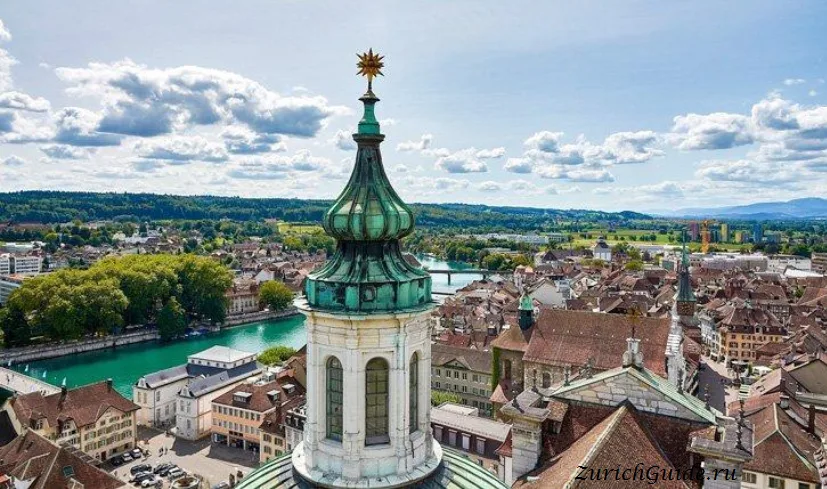
Solothurn
The finest baroque town in Switzerland, with eleven churches, eleven fountains, eleven towers and a cathedral with eleven altars, eleven bells and three flights of eleven steps.
Solothurn is on the Aare between Bern and Basel, and it is the most complete baroque town in Switzerland — the result of two hundred years as the seat of the French ambassador to the Swiss Confederation, whose presence brought French money, French architects and French taste.
It is also the town of eleven, and this is not a marketing invention.
Roman origins
Solothurn began as a Roman fort, Castrum Salodurum. A fragment of its wall survives, built into the side of a house near Friedhofplatz and Löwengasse, on the side of the old town away from the cathedral.
The eleven
Solothurn joined the Confederation as the eleventh canton in 1481, and took the number as its own with a thoroughness that is hard to explain and impossible to miss:
- eleven churches and chapels
- eleven fountains
- eleven towers
- the Cathedral of St. Ursus has eleven altars and eleven bells, and its grand staircase rises in three flights of eleven steps
- the town clock had eleven hours on its face
- the local beer is called Öufi — dialect for eleven — and is brewed at 11 hours 11 minutes
Nobody can fully account for it. The town has simply committed.
The cathedral
St. Ursen, built 1762–1773 by an architect from Ticino, is the great set piece: white and grey stone, a broad staircase with fountains on either side, and a tower you can climb.
It is regarded as the first significant neoclassical church in Switzerland, and the view from the top over the ochre roofs to the Jura is the photograph of Solothurn.
The cathedral is dedicated to St Ursus, one of two Roman legionaries said to have been beheaded in Solothurn for their Christian faith and later canonised; the town has also been called the town of St Ursus, and separately the City of Ambassadors. The architect, Gaetano Matteo Pisoni, kept the exterior to a restrained classical Italian style and let the interior run to full baroque ornament. The tower is 62 metres high, topped with a gilded Latin inscription recounting Ursus’s deeds.
The old town
Small, walled and almost entirely intact: two surviving town gates, the Zeitglockenturm with an astronomical clock and figures that move on the hour, arcaded streets, and the fountains — the Mauritius, the Samson, the St. George — each with a painted figure on a column.
The eastern Baseltor, the more handsome of the two gates, opens onto Hauptgasse, the street running the length of the old town past most of its sights, lined with restaurants and shops.
The Zeitglockenturm is the oldest building in town, dating to the twelfth century. It stands near the small Marktplatz, and its hands work in reverse of the usual convention: the short hand marks the minutes and the long hand the hours.
Among the eleven fountains, the Gerechtigkeitsbrunnen (Fountain of Justice), near the clock tower and dated 1561, is the most striking: a blindfolded figure of Justice holds a sword aloft and a balance lowered, with the Holy Roman Empire, the Pope, the Ottoman Sultan and the mayor of Solothurn seated at her feet.
Jesuitenkirche
West of the cathedral on Hauptgasse, the Jesuit church hides a stuccoed baroque interior behind a plain facade — the “marble” throughout is in fact wood and plaster. Built in the 1680s, it has a main altar from 1704 and a painting of the Assumption by Franz Karl Stauder.
The Museum Altes Zeughaus holds one of the largest collections of armour in Europe, several hundred suits of it, in the old arsenal.
The building recalls Solothurn’s centuries as a centre for mercenary soldiers, many of whom served the kings of France; the collection is arranged over four floors, from cannon to muskets, armour and uniforms.
The Kunstmuseum has, among other things, the Madonna in Strawberries, a small and very fine early-sixteenth-century panel that is the town’s treasure.
It also holds Ferdinand Hodler’s portrait of William Tell — red-haired, defiant, in a white shirt and short breeches — and the Solothurn Madonna (1522) by Hans Holbein the Younger.
The Aare
The river runs through the middle, swimmable in summer like the one in Bern and with the same warnings about current. Boats run downstream to Biel/Bienne and beyond through the Aare canals, a slow and rather beautiful three-hour trip through the marshland.
Between May and October, boats also call at Altreu, a village downstream with a colony of storks.
Nearby
- The Verena gorge — a wooded ravine at the edge of town with hermitages cut into the rock and a chapel; a hermit still lives there, appointed by the town, which is the last such post in Switzerland
- Weissenstein — the Jura ridge above, reached by cable car, with the whole Alpine chain laid out on the horizon on a clear day
- Schloss Waldegg, near Feldbrunnen — an eighteenth-century castle with an aristocratic interior open as a museum, set in baroque gardens
- Biel/Bienne — half an hour, and bilingual
- Bern — 40 minutes
Getting there
- By train — Bern 40 minutes, Basel 45 minutes, Zurich about an hour and a quarter.
- On foot — the old town is five minutes from the station across the river.
When to go
Any time. Late January brings one of the older carnivals in Switzerland, and the Solothurn Film Festival — the main showcase for Swiss cinema — fills the town for a week the same month.
Where to park in Solothurn
| Car park | Spaces | Fee | From centre |
|---|---|---|---|
| Baseltor underground | 488 | paid | 150 m |
| Bieltor underground | 450 | paid | 300 m |
| Underground car park | — | paid | 500 m |
| MDZ Obach | — | — | 620 m |
| Klinik Obach | — | — | 670 m |
| Nord | — | paid | 830 m |
| Ambulanzhalle soH Solothurn | 6 | — | 1.1 km |
| Open car park | 20 | — | 1.2 km |
Data © OpenStreetMap contributors, ODbL licence, snapshot of 22 August 2026. The map is drawn by volunteers: the list is not complete, and a dash means “not recorded” — not “free” and not “no spaces”. This is not an official parking directory: when you get there, read the signs and the machine at the entrance.
Weather in Solothurn month by month
| Month | Day | Night | Rainfall |
|---|---|---|---|
| January | +3° | -2° | 65 mm |
| February | +6° | -3° | 57 mm |
| March | +11° | +1° | 63 mm |
| April | +15° | +3° | 76 mm |
| May | +19° | +8° | 105 mm |
| June | +23° | +11° | 107 mm |
| July | +25° | +13° | 107 mm |
| August | +25° | +13° | 115 mm |
| September | +20° | +10° | 85 mm |
| October | +14° | +6° | 86 mm |
| November | +8° | +2° | 77 mm |
| December | +4° | -2° | 85 mm |
Normals for 1991–2020 from MeteoSwiss, station Koppigen, open data, version of 29 July 2026. Day and night are the average daily high and low, not records; rainfall is approximate. Current conditions from the Norwegian Meteorological Institute, CC BY 4.0.
Updated: