Scuol
Twenty springs, a bath house you can spend a day in, and villages covered in scratched plaster where the local language is Romansh.
Scuol is the main village of the Lower Engadin, in the far east of Switzerland near the Austrian border, and it sits on around twenty mineral springs — which is why people have been coming here since the sixteenth century.
This is Romansh country. The fourth national language is the everyday language here, on the shop signs, in the school and in the local paper, and the village is officially Scuol rather than the German Schuls. Of the 4,700 or so inhabitants, about half speak Romansh, some 40% Swiss German and a few per cent Italian.
The combination — Roman bathing tradition, Romansh culture, the only national park in the country and the skiing on Motta Naluns above the village — turned Scuol into a resort early. The first grand hotel, the neo-Renaissance Waldhaus Vulpera, opened in 1897 and was among the first hotels in the Swiss Alps; what remains of it is one of the Belle Époque monuments of Europe.
The water
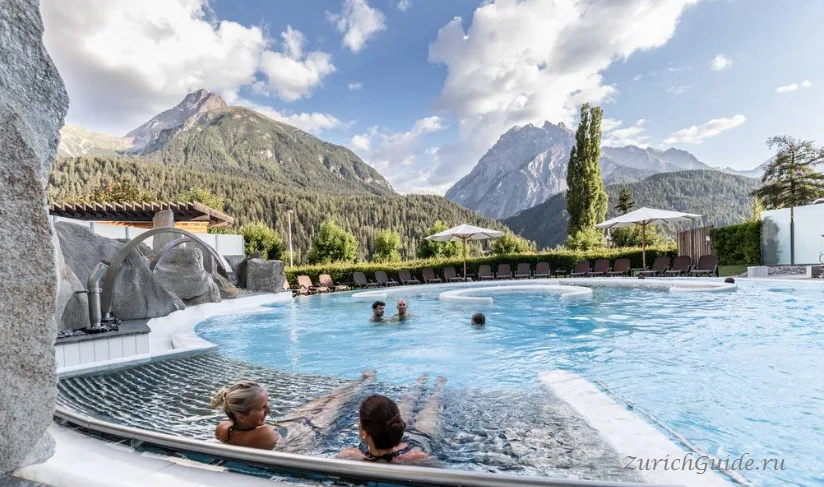
Bogn Engiadina is the modern bath complex: indoor and outdoor thermal pools, a large sauna area, and an Irish-Roman circuit — a fixed sequence of steam rooms, baths and rests done over about two hours with an attendant keeping you moving.
The rules about the sauna area apply, and they catch visitors out; see thermal baths.
The other half of the water is free: public fountains around the village run mineral water from different springs, each with a different composition, and you are meant to taste them. Most are strongly sulphurous and frankly unpleasant, which was historically taken as proof they worked. The Büvetta Tarasp, a grand nineteenth-century drinking hall down by the river, is derelict and being restored.
The sgraffito villages
The reason to stay a day rather than an afternoon.
Engadin houses are thick-walled with deep funnel-shaped window recesses, decorated with sgraffito — patterns scratched through white lime plaster to the darker layer beneath, with rosettes, scrolls and mottoes in Romansh.
Guarda is the finest and is a protected site; Ardez, Ftan and Sent are close behind. All are within twenty minutes by post bus, and each takes an hour to walk round.
Tarasp castle stands white on its rock across the valley and is visible from most of them.
Scuol’s own centre
You do not have to leave the village for this. The lower quarters are full of the same houses — small windows set in much larger painted frames, arched openings, wide barn gates — and the dates are cut into the facades, many of them reaching back to around 1610. The oldest building of all, now the Museum of the Lower Engadin, goes back to the twelfth century, though like everything here it has been rebuilt more than once. An hour or two is enough to walk it all, and the painted facades repay slow walking.
Three things in the village are on the national list of protected monuments: the reformed church, the old house known as Chasa Wieland, and the Kurhaus Bad Tarasp, the spa building down by the river.
The church itself — Baseglia evangelica San Göri, St George — is first recorded in 1178 and is among the oldest in the Engadin. It burned in 1258 and was rebuilt Romanesque, then remodelled in the Gothic style in the sixteenth century, which is how it stands now. At first glance the inside looks bare; walk in a little further and there are frescoes, badly faded but worth finding. The hill it stands on has produced Bronze Age finds from around 1500 BC.
The National Park
Half an hour up the valley at Zernez is the Swiss National Park, founded in 1914 and the oldest in the Alps — and the strictest: nothing is managed or planted, you must stay on the marked paths, and dogs and camping are forbidden.
Red deer, ibex, chamois, marmots and reintroduced bearded vultures. The visitor centre at Zernez explains the rules.
Getting there
- By train — Zurich about three hours via Landquart and the Vereina tunnel, which carries the train under the mountains and stays open when the passes are shut.
- By post bus between the villages, on the ordinary ticket.
- The Bernina and Glacier Express run through the same canton; St. Moritz is an hour and a half up the Engadin.
When to go
June to October for walking and the National Park, which closes for the winter.
Winter for cross-country skiing — the Engadin network is the best in Switzerland — and for the baths, which are at their best when it is snowing outside and you are in the open-air pool.
The valley is high, dry and sunny, with the largest day-to-night temperature swings in the country.
In numbers: July and August are the wettest months, with around eleven days of rain each, and March the driest. Winter days sit near freezing and drop to about −8 °C at night. Summer is mild rather than hot — 22 to 23 °C in July and August — which is the other reason people come.
Skiing on Motta Naluns is the local hill: a day pass costs around sixty francs, a week rather under three hundred, which is a different world from St. Moritz an hour up the valley. Check the current rates before counting on them.
Where to park in Scuol
| Car park | Spaces | Fee | From centre |
|---|---|---|---|
| Hotel Belvedere | — | paidmax 3 h | 120 m |
| Gallaria Milo | 11 | paidmax 1 h | 230 m |
| Coop Post | 6 | paidmax 15 min | 380 m |
| Multi-storey car park | — | paid | 470 m |
| Staziun RhB | — | paid | 1.1 km |
| Lischanahütteparkplatz | — | — | 1.4 km |
Data © OpenStreetMap contributors, ODbL licence, snapshot of 22 August 2026. The map is drawn by volunteers: the list is not complete, and a dash means “not recorded” — not “free” and not “no spaces”. This is not an official parking directory: when you get there, read the signs and the machine at the entrance.
Weather in Scuol month by month
| Month | Day | Night | Rainfall |
|---|---|---|---|
| January | 0° | -8° | 38 mm |
| February | +3° | -7° | 27 mm |
| March | +9° | -3° | 34 mm |
| April | +13° | +1° | 35 mm |
| May | +18° | +5° | 53 mm |
| June | +22° | +8° | 80 mm |
| July | +24° | +10° | 88 mm |
| August | +23° | +10° | 109 mm |
| September | +19° | +6° | 65 mm |
| October | +14° | +2° | 69 mm |
| November | +6° | -2° | 63 mm |
| December | +1° | -6° | 47 mm |
Normals for 1991–2020 from MeteoSwiss, station Scuol, open data, version of 29 July 2026. Adjusted to the elevation of the place. Day and night are the average daily high and low, not records; rainfall is approximate. Current conditions from the Norwegian Meteorological Institute, CC BY 4.0.
Updated: