Rapperswil
A castle on a rock, fifteen thousand rose bushes, and a wooden footbridge across the lake on a crossing that has existed since the Bronze Age.
Rapperswil sits at the far end of Lake Zurich where the water narrows, which is why there has been a crossing here since the Bronze Age — piles from a bridge of around 1500 BC have been found in the lake bed.
It is 40 minutes from Zurich by train, two hours by boat, and it is the most pleasant short trip out of the city.
The castle and the Poles
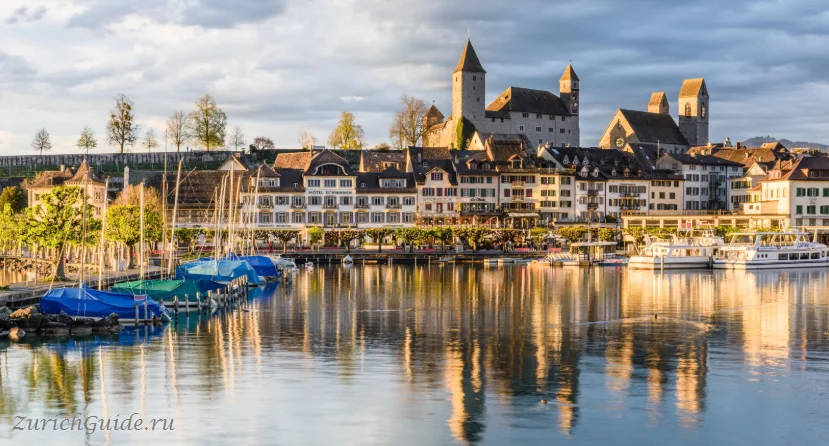
The Schloss stands on a rock above the old town, thirteenth-century, with three towers and a courtyard you can walk into free.
Inside is something unexpected: the Polish Museum. In 1870 a Polish count leased the castle and turned it into a museum of Polish history and a rallying point for exiles at a time when Poland did not exist as a state. It stayed, survived two world wars, and is still there — a national museum of one country inside a castle in another.
The castle is first recorded in 1229. Rudolf Brun, the mayor of Zurich, destroyed it in 1350; the Austrian duke Albrecht II rebuilt it in 1352–54. Its oddity among fortresses is the broad stairway up to it, lined with roses rather than closed off by a gate, and deer live in the grounds. There is a restaurant on site for days when the hall isn’t booked for a wedding. It’s three minutes’ walk from the station; the best view of it is from the wooden footbridge, and the best view of the town from a platform beside it. For other Swiss castles, see castles.
Around the old town
The Stadtpfarrkirche St. Johann, the Catholic parish church just east of the castle, shapes the skyline as much as the castle does. A church has stood on the site since 1229; the present one, replacing an earlier building lost to fire, was consecrated in 1885 and mixes architectural elements from seven centuries. The small Liebfrauenkapelle chapel beside it dates to 1489, next to a crypt that has stood there since the thirteenth century.
The Capuchin monastery, a short walk away, was founded in 1606 as a Catholic counterweight to Reformed Zurich; the building belongs to the town rather than the friars, the monastery is still active, and it keeps its own rose garden, open to the public.
On the waterfront below the castle wall is the Einsiedlerhaus, the “hermit’s house”, said to be the oldest surviving building in town: written record of it goes back to 981, when it lodged pilgrims crossing the lake. A rose garden surrounds it today.
The roses
Rapperswil calls itself the town of roses, and it means it: around 15,000 bushes in some 600 varieties, in three public gardens, one of which is designed for blind visitors with scented varieties and braille labels.
They are at their best from June to September and the gardens are free.
Two roses appear on the town’s coat of arms. The gardens include one at the Capuchin monastery and the one for blind visitors on the Schanze, along with beds around other public buildings.
The footbridge
A wooden footbridge runs 841 m across the lake from Rapperswil to Hurden — the longest in Switzerland, rebuilt in 2001 on the line of the medieval crossing, which itself followed the prehistoric one.
It takes fifteen minutes to walk and it is one of those small things that turns out to be the best part of the day. The pilgrim route to Einsiedeln crosses here, and there is a chapel on the far side.
The crossing was also used by pilgrims travelling on to Santiago de Compostela in Spain, on a bridge that by all accounts was none too safe: narrow, winding, with loose planking. In the nineteenth century a causeway open to pedestrians was built across the lake’s narrowest point.
The rest
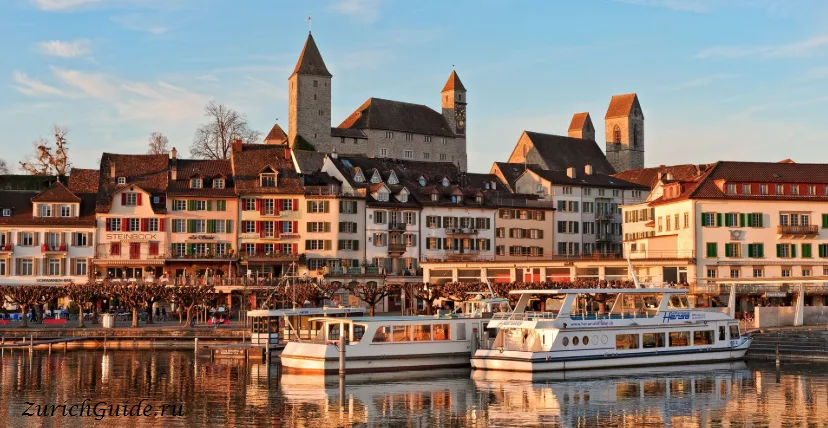
The old town is small and stepped, with painted houses and arcades under the castle rock.
The Circus Museum — Rapperswil was the winter quarters of Circus Knie, the Swiss national circus, and the family still keeps its animals here. There is a children’s zoo attached, which is the reason a lot of families make this trip.
The zoo dates back to 1962 and sits on the shore, a few minutes’ walk south-east of the station. Children can ride ponies, elephants and camels, among lions, giraffes and kangaroos on show. See travelling with children for more.
Festivals
The calendar runs from an autumn market and a cheese market, through the traditional Samichlaus processions — St Nicholas paraded through the streets ahead of Christmas — to a Christmas market and the town’s own carnival, Fasnacht, at winter’s end. Spring brings a spring festival; summer an Ironman triathlon, a blues and jazz festival, and La Tavolata, a communal table laid through the centre of town for an evening of food, closing with a fireworks festival on the lake, Seenachtfest. See festivals for more across Switzerland.
Getting there
- By boat — the better way in good weather. Two hours from Bürkliplatz in Zurich down the whole length of the lake, covered by a Swiss Travel Pass; see the lakes.
- By train — 40 minutes from Zurich HB, several an hour, along either shore.
- Combining — go one way by boat and the other by train.
Nearby
- Einsiedeln — half an hour further, with an enormous baroque abbey and a black madonna, one of the largest pilgrimage sites north of the Alps
- Zurich — see around Zurich for the other short trips
When to go
June to September for the roses and the boats. The bridge and the castle work year-round, and the lake in winter fog has its own argument.
Where to park in Rapperswil
| Car park | Spaces | Fee | From centre |
|---|---|---|---|
| Parkhaus See multi-storey | 112 | paid | 190 m |
| Parkhaus Schanz underground | — | paid | 210 m |
| Manor-Parkplatz multi-storey | — | paid | 320 m |
| Underground car park | — | paid | 350 m |
| Parkhaus ENTRA underground | 140 | paid | 360 m |
| Albuville underground | 100 | paid | 370 m |
| Teuchelweiher | 187 | paid | 500 m |
| Parkplatz Bahnhof Kempraten | 98 | paid | 1.3 km |
2 more are mapped nearby — see them on OpenStreetMap.
Data © OpenStreetMap contributors, ODbL licence, snapshot of 22 August 2026. The map is drawn by volunteers: the list is not complete, and a dash means “not recorded” — not “free” and not “no spaces”. This is not an official parking directory: when you get there, read the signs and the machine at the entrance.
Weather in Rapperswil month by month
| Month | Day | Night | Rainfall |
|---|---|---|---|
| January | +4° | -1° | 80 mm |
| February | +6° | -1° | 78 mm |
| March | +11° | +2° | 89 mm |
| April | +15° | +6° | 94 mm |
| May | +19° | +10° | 140 mm |
| June | +23° | +13° | 149 mm |
| July | +25° | +15° | 155 mm |
| August | +24° | +15° | 163 mm |
| September | +20° | +11° | 116 mm |
| October | +14° | +8° | 99 mm |
| November | +8° | +3° | 95 mm |
| December | +5° | 0° | 105 mm |
Normals for 1991–2020 from MeteoSwiss, station Wädenswil, open data, version of 29 July 2026. Adjusted to the elevation of the place. Day and night are the average daily high and low, not records; rainfall is approximate. Current conditions from the Norwegian Meteorological Institute, CC BY 4.0.
Updated: