Pontresina
The quiet, serious neighbour of St. Moritz: a climbing base at 1,800 m facing the Bernina glaciers, with a fraction of the prices.
Pontresina is five minutes from St. Moritz and a different proposition entirely. Where St. Moritz is a resort with a social calendar, Pontresina is a mountaineering village — the base for the Bernina group, with a guides’ association going back to the nineteenth century and a clientele that comes to walk and climb.
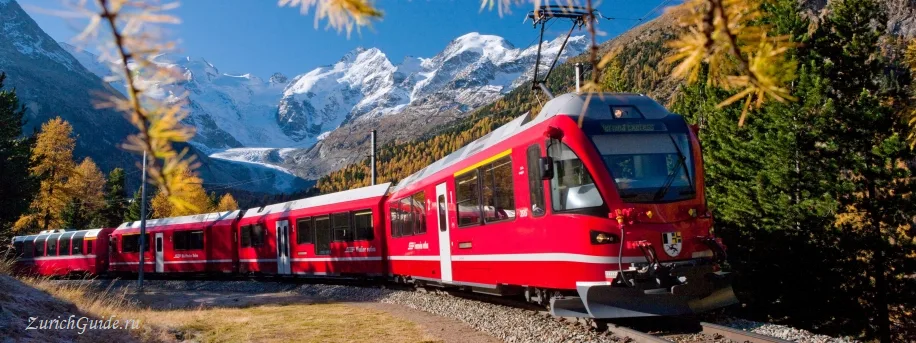
It sits at 1,805 m in the Bernina valley, facing south-west, sheltered from the north wind, and surrounded by the largest larch and stone pine forest in Switzerland — which turns gold in late September and is the reason a good number of Swiss visit at all.
The glaciers
Morteratsch is the accessible one: a railway halt of its own on the Bernina line, and a flat, easy path from the station up the valley to the ice.
The path is also a lesson. Markers along it show where the glacier snout stood in successive years — 1900, 1950, 1970, 2000 — and walking from one to the next takes a considerable time. The glacier has retreated roughly three kilometres since measurements began. Nothing about climate change is as legible as that walk.
Diavolezza, at 2,978 m, is the cable car opposite, with the Pers and Morteratsch glaciers laid out below and the Piz Bernina — the only 4,000er in the eastern Alps — in front. In winter there is a guided glacier descent from the top; in summer a mountain hut where you can stay the night and see the sunrise on the ice.
Muottas Muragl, reached by a funicular from 1907, has the best view in the Engadin for the least effort: the whole chain of lakes down to Sils, and a level panorama path along the ridge.
Walking and climbing
The Roseg valley runs south from the village, closed to cars, served by horse-drawn carriage or on foot, and ends at a glacier lake with a mountain inn. It is flat, about two hours each way, and among the most beautiful easy walks in Switzerland.
For climbers, the Bernina group is the point — Piz Palü, Piz Bernina and the Biancograt ridge, with huts and a long-established guiding tradition. The mountaineering school here is one of the oldest in the country.
The village
Sgraffito-decorated Engadin houses, a Belle Époque hotel or two left from the first tourist wave, and the church of Santa Maria above the village with thirteenth-century frescoes including a cycle of Mary Magdalene.
Sgraffito is worth looking at properly, because it is the decoration of this valley and of almost nowhere else: the plaster is laid in two layers, dark under light, and the pattern is scratched through the top one while it is still wet. Bands round the windows, dates over the doors, sundials, animals, sometimes a whole proverb along the wall.
The tourist office runs guided walks through the village and a separate tour of Santa Maria; both are short, and the church one is the better of the two if you have to choose. In summer there are also marmot and ibex excursions into the hills above — the ibex are most often seen on the slopes of Piz Languard.
Two more things the village has: Bellavita, the public pool and spa complex, which is where everyone ends up on a wet afternoon, and the Rondo hall, which puts on concerts through the season. Pontresina also carries Switzerland’s Family Destination label, which is a real certification about prams, cots, children’s menus and half-price lifts, not a slogan.
Prices are noticeably lower than in St. Moritz, five minutes away, for the same mountains.
Getting there
- By train — Zurich about three and a half hours via Chur; St. Moritz five minutes.
- The Bernina Express passes through, and the ordinary regional trains on the same line stop more often and cost less.
- Regional pass — the Engadin guest card, given at check-in, covers local transport and several lifts.
Winter
The ski season here runs from late autumn to the middle of May — long, because the skiing is high. Diavolezza and Corvatsch hold snow when lower resorts have given up, and the Engadin’s cross-country network is the best in the country.
For anyone not skiing: Muottas Muragl has the fastest toboggan run in the Engadin, 4 km of it from the top station back down to the valley, floodlit on some evenings.
When to go
Late September and early October for the larches, which is the local secret and worth planning around.
July to September for the walking and the glaciers; December to March for skiing at Diavolezza and Corviglia and for cross-country, which the Engadin does better than anywhere.
Where to park in Pontresina
| Car park | Spaces | Fee | From centre |
|---|---|---|---|
| Parkhaus Mulin underground | — | — | 100 m |
| Rondo underground | — | paid | 330 m |
| Open car park | 31 | paid | 730 m |
Data © OpenStreetMap contributors, ODbL licence, snapshot of 22 August 2026. The map is drawn by volunteers: the list is not complete, and a dash means “not recorded” — not “free” and not “no spaces”. This is not an official parking directory: when you get there, read the signs and the machine at the entrance.
Weather in Pontresina month by month
| Month | Day | Night | Rainfall |
|---|---|---|---|
| January | -2° | -17° | 29 mm |
| February | 0° | -16° | 19 mm |
| March | +3° | -10° | 24 mm |
| April | +7° | -5° | 37 mm |
| May | +12° | -1° | 67 mm |
| June | +16° | +3° | 91 mm |
| July | +19° | +4° | 87 mm |
| August | +18° | +4° | 100 mm |
| September | +14° | +1° | 73 mm |
| October | +10° | -3° | 77 mm |
| November | +3° | -9° | 70 mm |
| December | -1° | -14° | 37 mm |
Normals for 1991–2020 from MeteoSwiss, station Samedan, open data, version of 29 July 2026. Adjusted to the elevation of the place. Day and night are the average daily high and low, not records; rainfall is approximate. Current conditions from the Norwegian Meteorological Institute, CC BY 4.0.
Updated: