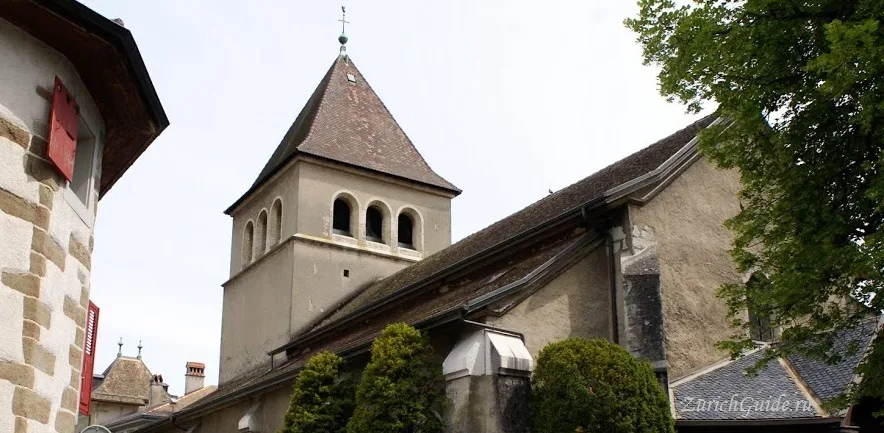
Nyon
Founded by Julius Caesar's veterans, with a five-towered castle above the lake, a porcelain tradition, and UEFA's headquarters at the edge of town.
Nyon sits on Lake Geneva between Geneva and Lausanne, in the wine country of La Côte, and it is considerably older than either as a town: Julius Caesar’s veterans founded a colony here around 45 BC, Colonia Iulia Equestris.
Today it is a prosperous small town of about 21,000, 25 km east of Geneva, with a white castle above the harbour and the headquarters of UEFA on the outskirts — European football is administered from a lakeside office five minutes from a Roman forum. It has been a quiet resort since Victorian times and still feels like one.
Before and after the Romans
People were living on this shore in the Neolithic, and the Helvetii were here before Caesar; the town itself begins in 45 BC, when the colony was founded and its centre, Noviodunum, laid out on the site of the present town. It went on prospering for two centuries after Caesar’s death, and declined in the third — which is roughly when the Roman stonework started being reused in everything built since.
The castle
Château de Nyon, twelfth-century with five towers and a white render that makes it visible from the whole lake, stands above the old town.
Inside is the town museum, and the collection worth seeing is the porcelain: Nyon had a porcelain manufactory from 1781 to 1813 that produced work of genuine quality in a very short life, and the museum holds the best collection of it.
The terrace behind the castle gives the lake and, on a clear day, Mont Blanc.
Roman Nyon
Three Roman columns stand on the esplanade above the harbour — re-erected in the 1950s from fragments of the basilica, and the town’s emblem.
The Musée Romain is built into the remains of the basilica itself, under the square, and covers the colony properly. The Musée du Léman, down by the water, covers the lake — its boats, its fish and its history — and has an aquarium of lake species.
Three museums, all small, all within five minutes of each other.
The lakefront
A promenade, a harbour full of boats, and the CGN steamers calling on their way along the lake. Across the water is France, and the boats to Yvoire — a walled medieval village on the French shore, one of the prettiest on the lake — take about twenty minutes.
Paléo
For six days in July, Nyon hosts the Paléo Festival, the largest open-air music festival in Switzerland: around 230,000 visitors over the week, on a site outside the town.
It sells out within hours of tickets going on sale, months ahead. If you are not going, the town is full and the trains are packed for that week.
The wine
Nyon is in La Côte, the largest wine region of canton Vaud — Chasselas again, and less known than Lavaux at the other end of the lake. The villages behind the town have cellars open at weekends in season, and a marked path runs between them.
Getting there
- By train — Geneva 15 minutes, Lausanne 20 minutes, and both very frequent.
- By boat — the lake steamers from Geneva and Lausanne, and the crossing to Yvoire in France.
- On foot — everything above is within ten minutes of the station.
- By bike — hire one at the station, around 30 francs a day, which is the sensible way to see the vineyards of La Côte behind the town.
- Regional pass — if you are working your way round Lake Geneva, the regional pass pays for itself quickly; it covers trains, buses and most of the boats.
Finding your way
The station stands about 500 m above the lake. Walk down the Rue de la Gare and after 300 m you are in the centre; the Grand Rue runs through it, and the signs to the museums and the castle do the rest.
From the castle a road runs parallel to the shore. Turn right and go down for the Musée du Léman; keep straight on for the Musée Romain and the terrace with the Roman columns, which is also the best view over the town and the lake. The restaurants are almost all on the Rue de Rive, along the water.
When to go
May to September for the lake and the boats. July for Paléo, if you have a ticket, and not otherwise.
Where to park in Nyon
| Car park | Spaces | Fee | From centre |
|---|---|---|---|
| La Duche underground | — | paid | 160 m |
| Bel-Air underground | — | paid | 190 m |
| Petit-Perdtemps | — | paid | 210 m |
| Place Perdtemps | 200 | paid | 240 m |
| Gare de Nyon multi-storey | — | paid | 390 m |
| Rive-Est | — | paid | 440 m |
| La Combe underground | — | paid | 440 m |
| P+R Nyon CFF | — | — | 470 m |
7 more are mapped nearby — see them on OpenStreetMap.
Data © OpenStreetMap contributors, ODbL licence, snapshot of 22 August 2026. The map is drawn by volunteers: the list is not complete, and a dash means “not recorded” — not “free” and not “no spaces”. This is not an official parking directory: when you get there, read the signs and the machine at the entrance.
Weather in Nyon month by month
| Month | Day | Night | Rainfall |
|---|---|---|---|
| January | +5° | 0° | 82 mm |
| February | +7° | 0° | 63 mm |
| March | +11° | +3° | 64 mm |
| April | +15° | +6° | 67 mm |
| May | +20° | +9° | 86 mm |
| June | +24° | +13° | 84 mm |
| July | +26° | +15° | 84 mm |
| August | +26° | +15° | 84 mm |
| September | +21° | +12° | 86 mm |
| October | +15° | +8° | 98 mm |
| November | +9° | +3° | 96 mm |
| December | +6° | +1° | 100 mm |
Normals for 1991–2020 from MeteoSwiss, station Nyon / Changins, open data, version of 29 July 2026. Adjusted to the elevation of the place. Day and night are the average daily high and low, not records; rainfall is approximate. Current conditions from the Norwegian Meteorological Institute, CC BY 4.0.
Updated: