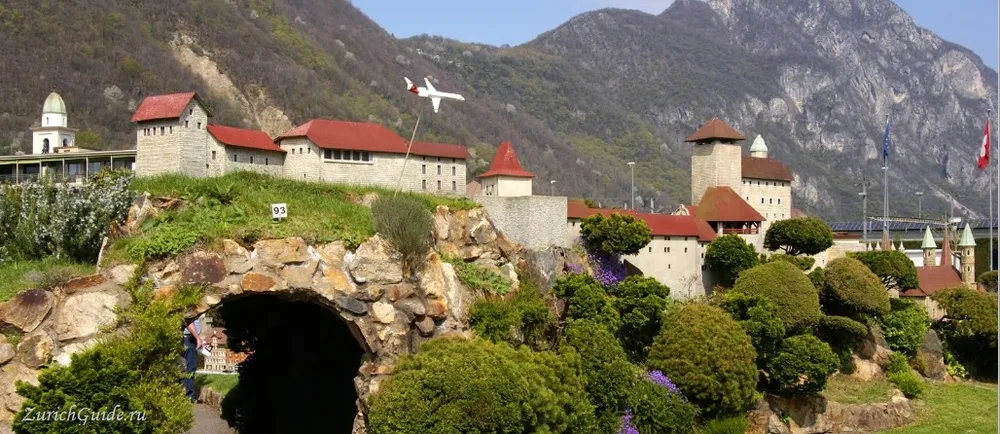
Melide and Swissminiatur
A park on Lake Lugano containing 130 Swiss buildings at one twenty-fifth scale, with three and a half kilometres of model railway running through them.
Melide is a village on Lake Lugano, on the causeway that crosses the lake, and it contains Swissminiatur — the whole of Switzerland at 1:25.
The park has around 130 models: the Federal Palace in Bern, the Château de Chillon, the Kapellbrücke, the Matterhorn, the Munot, the abbey at St. Gallen, the Bellinzona castles, Zurich’s churches — laid out on 14,000 square metres of garden with 15,000 real plants, many of them dwarf conifers pruned to scale.
Running through it are 3.5 km of model railway, with eighteen trains, plus funiculars, cable cars, boats on the model lakes and an airport. It opened in 1959 and has been added to ever since.
Is it worth it?
It depends entirely on who you are.
With children — yes, unreservedly. It is the best two hours of a Ticino trip for anyone under twelve, and the trains are the reason.
As a planning tool — better than you would expect. Seeing the country’s landmarks laid out geographically at a scale you can walk round in an hour clarifies where things actually are, which no map quite does.
As an adult with no particular interest in models — an hour, pleasantly, and then the lake.
It is the sort of attraction that is easy to be superior about and rather good when you get there. The modelling is meticulous, and the buildings were made from measured drawings.
What is actually in it
Everything is numbered, and you are handed a booklet at the entrance listing the numbers in English, French, German or Italian — useful, because guessing what you are looking at is harder than it sounds and gets competitive.
Number one is the William Tell monument at Altdorf in canton Uri. After that the country unfolds more or less geographically: the cathedral of Geneva, the Château de Chillon, the Dazio Grande toll house at Rodi-Fiesso here in Ticino, the Suvorov monument at Andermatt, Zurich airport as it looked in 1958, and, since Ticino faces south, a model of Milan cathedral to finish.
The point is not the individual buildings but the walk between them: funiculars climbing model mountains, boats crossing model lakes, and trains that actually run. Children stop at the railway and stay there.
Practical
- Open roughly mid-March to early November, closed in winter; daily, from morning to early evening.
- Allow one and a half to two hours to see all of it; there is a café and a picnic area.
- The lake boats stop at Melide, which is the pleasant way to arrive.
- Paid entry, with a family rate and a reduced rate for children and pensioners; under-sixes go free. Not included in transport passes — check the current prices before you go, they have moved over the years.
Getting there
- By train — Lugano to Melide is about six minutes; Zurich about two and a half hours via the Gotthard Base Tunnel.
- By boat — from Lugano in half an hour.
- By car — the A2 runs over the causeway; there is parking at the park.
Around Melide
- Morcote — fifteen minutes along the shore, arcaded and steep, and regularly voted the prettiest village in Switzerland
- Monte San Salvatore — the funicular from Lugano, with the whole lake below
- Monte San Giorgio — across the water, UNESCO-listed for its Triassic marine fossils, with the museum at Meride
- Lugano — six minutes, and the reason most people are in Ticino at all
Where to park in Melide and Swissminiatur
| Car park | Spaces | Fee | From centre |
|---|---|---|---|
| BUS | — | — | 180 m |
| Open car park | 20 | paid | 230 m |
| P+Rail Melide | — | paid | 280 m |
| Open car park | 51 | paid | 320 m |
| Open car park | 22 | — | 1.4 km |
Data © OpenStreetMap contributors, ODbL licence, snapshot of 22 August 2026. The map is drawn by volunteers: the list is not complete, and a dash means “not recorded” — not “free” and not “no spaces”. This is not an official parking directory: when you get there, read the signs and the machine at the entrance.
Weather in Melide and Swissminiatur month by month
| Month | Day | Night | Rainfall |
|---|---|---|---|
| January | +7° | -1° | 54 mm |
| February | +8° | 0° | 51 mm |
| March | +13° | +4° | 65 mm |
| April | +17° | +8° | 103 mm |
| May | +21° | +13° | 129 mm |
| June | +25° | +17° | 123 mm |
| July | +27° | +19° | 104 mm |
| August | +27° | +19° | 119 mm |
| September | +23° | +14° | 116 mm |
| October | +18° | +10° | 122 mm |
| November | +12° | +5° | 135 mm |
| December | +7° | +1° | 69 mm |
Averages for 1991–2020, computed from NASA POWER daily data and corrected for the elevation of the place (279 m). Day and night are the average daily high and low, not records; rainfall is approximate. Current conditions from the Norwegian Meteorological Institute, CC BY 4.0.
Updated: