Meiringen and the Reichenbach Falls
The waterfall where Conan Doyle killed Holmes, a funicular to the ledge, and a village that has made the most of a fictional death.
Meiringen is a modest village in the Hasli valley east of Interlaken, and it is world-famous for something that never happened there.
The village sits in the Bernese Oberland, close to Lake Brienz, on the route between Interlaken and Lucerne, in the valley the Aare has cut through the mountains.
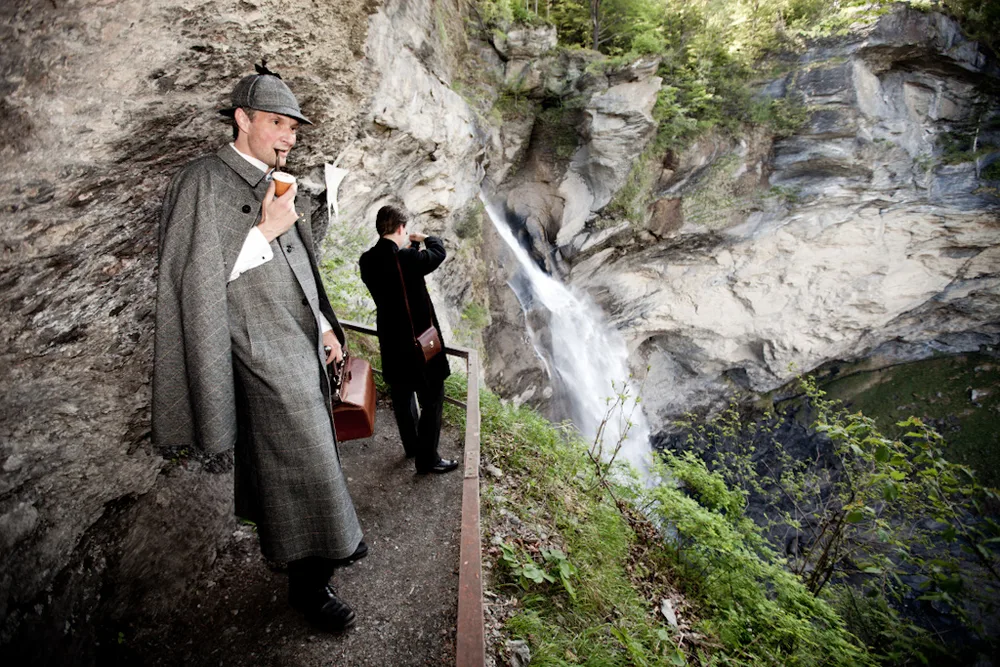
In 1893 Arthur Conan Doyle, tired of his detective, took him to the Reichenbach Falls and had him go over the edge locked in Professor Moriarty’s arms. Conan Doyle had visited the falls himself in 1891 and picked them deliberately: he wanted a grave worthy of the character.
The public reaction was such that he had to bring Holmes back eight years later, explaining that he had never fallen at all.
The falls
The Reichenbachfall drops about 250 m in a series of cascades. A funicular from 1899 climbs to a viewing platform, and from there a path leads to the ledge marked — with a white star on the rock — as the place where the fight is supposed to have happened.
It is a real waterfall and an impressive one, and the fictional layer sits lightly on top. The funicular runs from about May to October.
A path continues above the platform, a walk of around twenty minutes, following the top of the falls where the water has cut hollows and channels into the rock over the years. Conan Doyle gave the falls a suitably alarming description in “The Final Problem”, dwelling on the noise, the spray and the sheer drop.
The Holmes industry
The village has embraced it entirely and with better taste than it might have.
The Sherlock Holmes Museum in the old English church reconstructs the sitting room at 221B Baker Street from the descriptions in the stories, item by item — the Persian slipper with the tobacco, the letters pinned to the mantelpiece with a jackknife. There is a statue of Holmes on the square outside, and a plaque from the Sherlock Holmes Society of London.
Conan Doyle’s son unveiled part of it. The whole thing is done with a straight face and it works.
The gorges
The other reason to come, and the one locals would put first.
The Aare gorge — Aareschlucht — runs 1,400 m through limestone the river has cut to a slot barely a metre wide in places, with walls up to 180 m high. A walkway of galleries and tunnels runs through it, and it is genuinely startling. Open roughly April to October, and floodlit on some summer evenings.
In places the gorge walls open into caves, some of them large enough to step into from the walkway.
Rosenlaui gorge, higher up the valley, is smaller, wilder and cut by glacial meltwater. Fewer people get there, and it is the better of the two if you have time for one.
Meringues
The village claims the invention of the meringue — the story being that an Italian pastry cook named Gasparini made it here in the eighteenth century and the town gave it its name. The evidence is thin and the bakeries do not care. They are excellent regardless, and served with double cream.
Hasliberg and the Haslital
Above Meiringen, on the other side of the valley, lies Hasliberg, part of the wider Haslital and aimed mostly at families with children. It is reached by cable car or post bus from the village.
In summer the area has more than 300 km of paths for walking and mountain biking, including a themed trail called Muggestutz, built around the local legend of the Hasli gnomes.
In winter, around 15 lifts serve the plateau at Planplatten (roughly 2,250 m), with cross-country routes, sledging runs and an extensive network of winter walking paths. The Alpine Tower at Planplatten is a panoramic restaurant with a 360-degree view of the surrounding peaks.
Getting there
- By train — Interlaken Ost about half an hour on the Brünig line; Lucerne about an hour and a quarter. This is the same line as the GoldenPass.
- On foot — the funicular station is fifteen minutes from the village.
- From Zurich — around two and a quarter hours, changing either at Bern and Interlaken Ost, or travelling via Lucerne.
- By car — free parking is plentiful in the village, including next to the funicular station.
- Regional passes covering transport across the Bernese Oberland and the Lucerne area can bring down the cost of the train, the funicular and the lifts — see tickets and passes.
Nearby
- Grimsel, Susten and Furka passes — the three great pass roads meet at the head of this valley, and the post bus over them in summer is one of the best bus rides in Europe
- Interlaken and the Jungfrau region — half an hour west
- Ballenberg — the open-air museum of Swiss rural buildings, twenty minutes away, with a hundred historic houses moved here from across the country
When to go
May to October, when the funicular, the gorges and the passes are open. Outside that the village is quiet and most of what is listed here is shut.
Where to park in Meiringen and the Reichenbach Falls
| Car park | Spaces | Fee | From centre |
|---|---|---|---|
| Migros | — | paid | 160 m |
| Parkhotel du Sauvage | — | — | 200 m |
| Car park | 22 | — | 310 m |
| Meiringen-Hasliberg | — | — | 430 m |
| Alpbach | — | paid | 530 m |
Data © OpenStreetMap contributors, ODbL licence, snapshot of 22 August 2026. The map is drawn by volunteers: the list is not complete, and a dash means “not recorded” — not “free” and not “no spaces”. This is not an official parking directory: when you get there, read the signs and the machine at the entrance.
Weather in Meiringen and the Reichenbach Falls month by month
| Month | Day | Night | Rainfall |
|---|---|---|---|
| January | +5° | -4° | 79 mm |
| February | +5° | -4° | 69 mm |
| March | +8° | 0° | 83 mm |
| April | +12° | +5° | 105 mm |
| May | +18° | +10° | 144 mm |
| June | +23° | +14° | 149 mm |
| July | +25° | +15° | 143 mm |
| August | +25° | +15° | 149 mm |
| September | +21° | +12° | 117 mm |
| October | +16° | +8° | 110 mm |
| November | +10° | +3° | 111 mm |
| December | +6° | -2° | 93 mm |
Averages for 1991–2020, computed from NASA POWER daily data and corrected for the elevation of the place (596 m). Day and night are the average daily high and low, not records; rainfall is approximate. Current conditions from the Norwegian Meteorological Institute, CC BY 4.0.
Updated: