Lausanne
A steep university city on Lake Geneva with the finest Gothic cathedral in Switzerland, a night watchman who still calls the hours, and the only metro in the country.
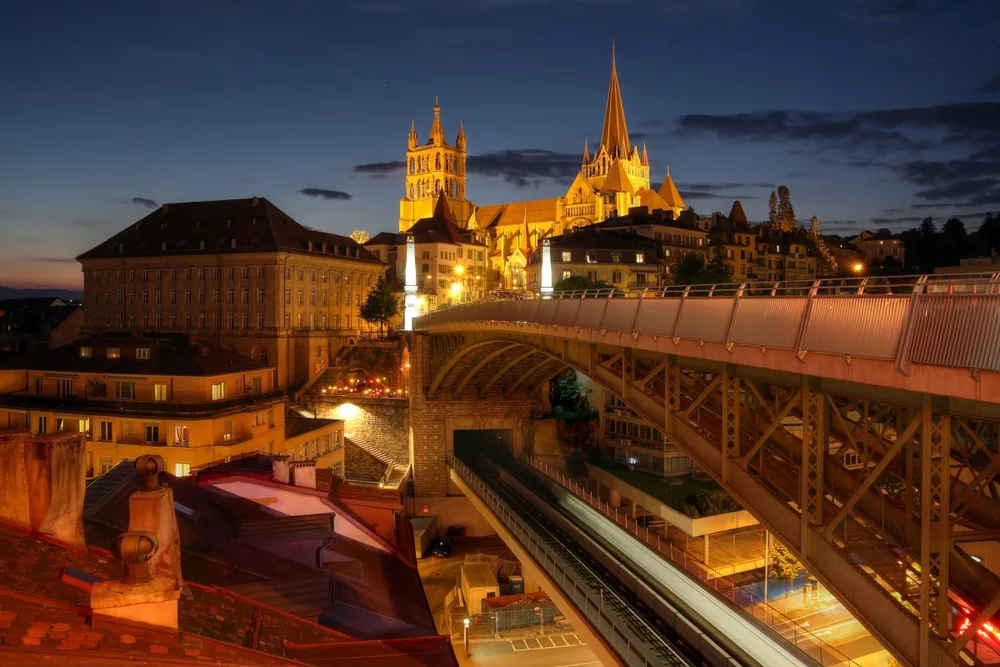
Lausanne is built on three hills falling to Lake Geneva, and the gradients are serious enough that the city runs Switzerland’s only metro — a driverless line that climbs 370 m from the lakeshore to the northern edge and is, in places, closer to a funicular than an underground.
It is a university town, the fourth city of Switzerland, and the seat of the International Olympic Committee, which has been here since 1915.
History
People have lived on this slope since the Stone Age, and a Roman town stood here before Lausanne took its present shape. For centuries the city was a refuge for exiles of every kind, deposed monarchs among them, and its Enlightenment-era connections — both Rousseau and Voltaire had links to it — helped give it the reputation for restraint and refinement that many French-speaking Swiss still associate with it. In 1803 the canton of Vaud, of which Lausanne is the capital, joined the Swiss Confederation.
The cathedral
Notre-Dame de Lausanne is the most important Gothic building in Switzerland, consecrated in 1275 in the presence of a pope and an emperor. The painted portal, restored to its medieval colours, gives some idea of how these buildings actually looked before the Reformation stripped them.
The thing to know: the night watch still calls the hours. Every night between ten and two, a watchman climbs the tower and calls out the time to each of the four points of the compass — “C’est le guet; il a sonné dix” — a duty performed without interruption since 1405. It is one of the oldest continuously observed customs in Europe, and you can stand in the square and hear it.
The tower is 232 steps and gives the lake and the Alps of Savoy.
Construction had begun a century earlier, in 1175; the pope who consecrated the finished building was Gregory X, and while in Lausanne he met the German emperor Rudolf of Habsburg. The floor plan is slightly irregular — the apse leans a few degrees off the axis of the nave, as though the building were inclining its head. In the Middle Ages the cathedral was a major pilgrimage site, drawing as many as 70,000 visitors a year to a town of around 7,000 people. The interior is plain by comparison with the exterior — the Reformation cleared out the furnishings, along with 12th-century gold and silver statues of the Virgin and Child that had stood on the altar — but the carved wooden choir stalls survive from the 13th century, as does the round window in the south transept, showing saints, the signs of the zodiac and the labours of the months. The cathedral also holds the largest organ in Switzerland, with some seven thousand pipes. It was restored in the 19th century under the French architect Eugène Viollet-le-Duc, better known for his work on Notre-Dame de Paris.
The old town
Steep, medieval and student-heavy: the Escaliers du Marché, a covered wooden stair running up to the cathedral, the Place de la Palud with its painted town hall and a clock whose figures parade on the hour, and a food market on Wednesday and Saturday mornings.
The city is built on three steep ridges, and the railway station sits roughly halfway up the slope, so most visitors work it in one direction: down to the lake, then back up by metro. From Ouchy the line climbs to Riponne, a large square dominated by the Palais de Rumine, a late 19th-century building in the Florentine Renaissance style, paid for by the Russian Bestuzhev-Ryumin family and finished in 1904. It housed the University of Lausanne until 1980 and now holds the cantonal and university libraries along with several small museums — fine art, archaeology, coins, geology and zoology. From Riponne it is a short climb to the cathedral, and from there the streets fall back down past the Escaliers du Marché to Place de la Palud and the lower town.
On the way, Place Saint-François is the old town’s other historic square, named for the Franciscan church that still stands on it. The church was finished in 1272 and was once the centre of a large monastery; its nave was rebuilt and a clock tower added after a fire in 1368. The monastery closed when the Reformation reached Lausanne with Bernese troops in 1536, and the church became the parish church of the lower town — an English judge, John Lisle, who had fled to Lausanne after the execution of Charles I, was murdered inside it by royalist agents in 1664. The rest of the monastic buildings were demolished at the end of the 19th century.
Ouchy and the lake
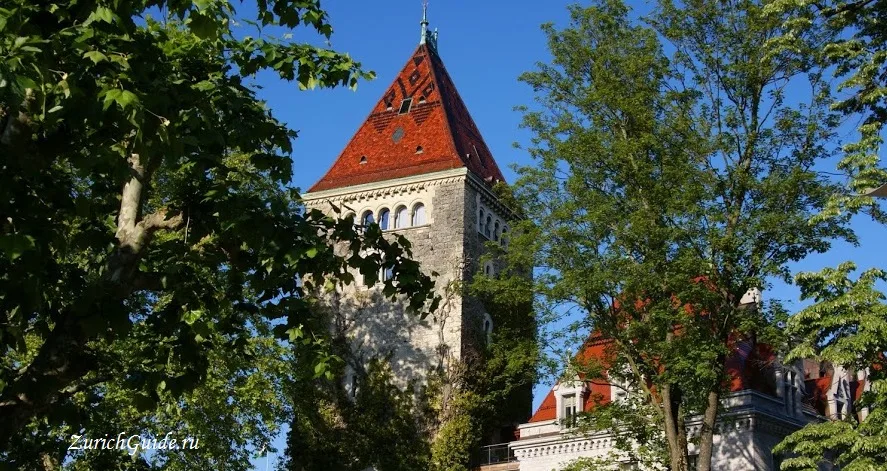
Down at the water, Ouchy is the lakefront quarter: a promenade of plane trees, boats to Évian in France and along the shore to Montreux and Vevey, and the château where Byron wrote The Prisoner of Chillon over two days while sheltering from the rain.
The metro connects it to the centre in seven minutes, which saves a stiff climb.
The château itself is older than the hotel that now occupies it. It began as the residence of the bishops of Lausanne around 1170; its tower was pulled down in 1207 and rebuilt soon after, and the building served as a prison once Bern took control of Vaud in 1536. Fire damaged it badly in 1609. The canton bought it in 1885 and rebuilt part of it in neo-Gothic style as the hotel standing there today.
Lausanne has one more literary footnote, a Russian one. A young Marina Tsvetaeva boarded at a school here in 1903–04, and a plaque on a house on Boulevard de Grancy, on the way down from the station, marks where she stayed — its text is partly in pre-revolutionary Russian. She later wrote a poem remembering the evening light over Ouchy.
The museums
The Olympic Museum at Ouchy is the obvious one and better than expected — the torches, the medals, the history, and a park of sculpture running down to the water.
The museum opened in 1993, prompted by the fact that the IOC itself had been based in Lausanne since 1915; its holdings run from antiquity — coins and stamps connected with the ancient Games — to a video archive of more recent ones.
Collection de l’Art Brut is the one worth going out of your way for: Jean Dubuffet’s collection of art made by people outside the art world entirely — psychiatric patients, prisoners, mediums, recluses. There is nothing else like it, and it is unsettling in the way it is meant to be.
The collection is housed in the Château de Beaulieu, a house dating from 1756.
Plateforme 10, beside the station, gathers three museums — fine art, design and photography — into one new complex.
Two more collections sit right by the cathedral. The Musée historique de Lausanne, in the old bishop’s palace, keeps a fortified 13th-century tower and a large model of the 17th-century old town. MUDAC, the design museum next door, pairs a collection of contemporary glasswork with older pieces from ancient Egypt and China.
West of Ouchy, the Musée romain de Lausanne-Vidy stands on the site of Lousonna, the Roman town that preceded Lausanne; the finds on show include coins and everyday objects from the settlement.
Getting there
- By train — Geneva 35 minutes, Bern an hour and ten, Zurich about two hours ten.
- By boat — the lake steamers from Geneva, Montreux and Évian call at Ouchy.
- The metro runs from the station down to Ouchy and up to the northern suburbs; it is included in city tickets, and Lausanne hotels give guests a free transport card.
Nearby
- Lavaux — the vineyard terraces begin at the eastern edge of the city
- Vevey and Montreux — 20 and 30 minutes along the shore
- Évian and Yvoire — across the water in France, by boat
- Geneva — under 40 minutes by train, or by lake steamer
- Nyon and Morges — smaller lakeside towns further along the north shore, each an easy stop on the same line
- Château de Chillon — the castle from Byron’s poem, beyond Montreux at the far end of the lake
- Lavaux by panoramic train — a small tourist train runs up through the vineyard terraces from the lakeshore, a slower alternative to walking the Lavaux path
When to go
April to October for the lake. The city works year-round otherwise, and being a university town it does not empty in the way resorts do. The Fête du Blé et du Pain and the Lausanne Marathon fill particular weekends; the night watch calls every night regardless.
Where to park in Lausanne
| Car park | Spaces | Fee | From centre |
|---|---|---|---|
| Parking Riponne underground | — | paid | 200 m |
| Parking du Rôtillon underground | — | paid | 230 m |
| Parking du Valentin underground | 89 | paid | 240 m |
| Parking du Grand-Chène multi-storey | — | paid | 260 m |
| Parking du Palace underground | — | paid | 340 m |
| Place du Château | 53 | paid | 370 m |
| Parking du Valentin underground | — | paid | 440 m |
| Parking Montbenon underground | — | paid | 540 m |
13 more are mapped nearby — see them on OpenStreetMap.
Data © OpenStreetMap contributors, ODbL licence, snapshot of 22 August 2026. The map is drawn by volunteers: the list is not complete, and a dash means “not recorded” — not “free” and not “no spaces”. This is not an official parking directory: when you get there, read the signs and the machine at the entrance.
Weather in Lausanne month by month
| Month | Day | Night | Rainfall |
|---|---|---|---|
| January | +4° | 0° | 75 mm |
| February | +6° | +1° | 64 mm |
| March | +10° | +3° | 72 mm |
| April | +14° | +7° | 84 mm |
| May | +19° | +10° | 113 mm |
| June | +23° | +14° | 107 mm |
| July | +25° | +16° | 103 mm |
| August | +24° | +16° | 110 mm |
| September | +20° | +12° | 98 mm |
| October | +14° | +9° | 111 mm |
| November | +9° | +4° | 99 mm |
| December | +5° | +1° | 98 mm |
Normals for 1991–2020 from MeteoSwiss, station Pully, open data, version of 29 July 2026. Day and night are the average daily high and low, not records; rainfall is approximate. Current conditions from the Norwegian Meteorological Institute, CC BY 4.0.
Updated: