Kandersteg
A quiet village at the end of a valley, with the best short walk in Switzerland above it and a car-carrying train under the mountains behind it.
Kandersteg sits at 1,170 m at the head of the Kander valley, an hour from Bern, and it is the base for one of the best things in the country.
The village itself is modest — a long street of chalets and hotels, quiet, with none of the polish of the big resorts. Its role is as a starting point.
Around 1,200 people live here, ringed by some of the higher peaks in the Bernese Oberland: the Balmhorn (3,698 m) on the cantonal border with Valais to the south, the Blüemlisalp (3,663 m) to the east, and the Gross Lohner (3,049 m), the highest point between the Kander valley and Adelboden, to the west. Part of the municipality falls inside the Jungfrau-Aletsch UNESCO World Heritage area, listed in 2001, which takes in both the Oeschinensee and the Gasterntal.
History
The Gasthof Ruedihaus, a hotel-restaurant in the village, is listed as a heritage building of national significance.
Kandersteg has been a winter sports destination for more than a century, popularised originally by British visitors who came mainly for the curling.
Oeschinensee
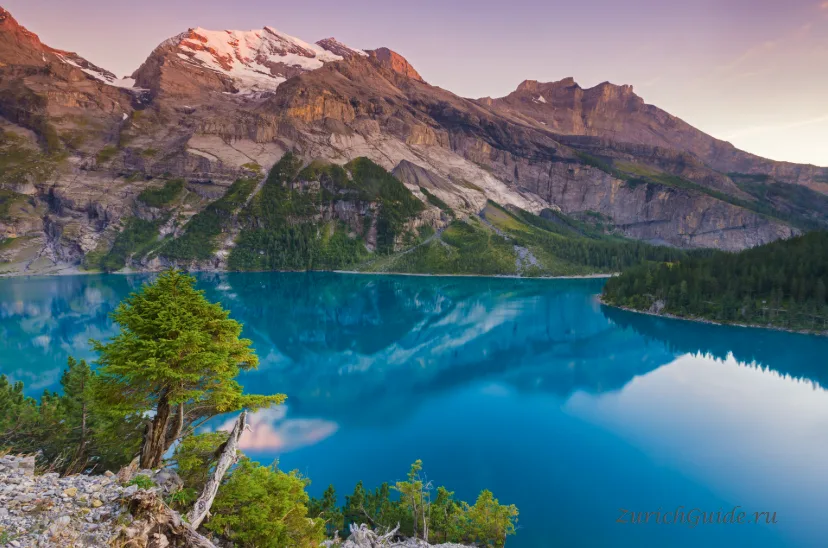
The reason to come. A gondola and twenty minutes on foot bring you to a turquoise lake in a cirque of 3,000-metre walls, with waterfalls coming off them straight into the water.
It is UNESCO-listed and it is the best return on effort in Switzerland. Full details on the Oeschinensee page.
The lake itself sits at 1,578 m, the largest in the area, below the Blüemlisalp massif. On foot from the village it’s a three-kilometre path, about an hour, open through the winter as well. The gondola climbs the same hillside in around nine minutes, and from its Oeschinen station there is also a summer luge run, a toboggan on a fixed metal chute. From the top station, an electric shuttle bus also runs down to the lake, roughly every half hour. A handful of mountain restaurants and hotels stand at the water’s edge.
Blausee
Ten minutes down the valley: a very small lake in forest, of the same improbable blue, fed by underground springs and so clear that the trout appear to be floating in air.
It is privately owned and there is an entry charge, which some people resent and which keeps it in the condition it is in. There is a trout farm, a hotel and a short circuit path. Half an hour, and worth it on the way past.
The Lötschberg tunnel
Behind the village, the car-carrying rail shuttle runs through the Lötschberg tunnel to Goppenstein in the Valais — you drive onto a flat wagon and are taken under the mountains in fifteen minutes.
It runs all year, several times an hour, and it is how you get from the Bernese Oberland to the Valais in winter when the passes are shut. See driving in Switzerland.
Walking
Kandersteg is a serious walking base:
Over the Gemmi to Leukerbad — a full day across a high pass into the Valais, ending at a thermal bath, with a cable car down at the far end. One of the classic crossings.
Gasterntal — a wild, narrow valley behind the village, reached by a single-track road with traffic-light control, and almost untouched.
The Doldenhorn and Blüemlisalp huts — proper mountain routes for the equipped.
Arthur Conan Doyle sent Sherlock Holmes and Dr Watson over the Gemmi in the other direction, from Leukerbad to Kandersteg, and on from here to Meiringen and Holmes’s fight with Moriarty at the Reichenbach Falls.
In winter there is a small ski area, and the frozen Oeschinensee becomes a walking and skating surface. Kandersteg is better known in winter for cross-country skiing and for ice climbing.
Skiing
The skiing is modest but real: 14 km of pistes on seven lifts — four red runs and three blue — dropping close to 800 m from around 1,960 m at the top lift down towards the village. Two areas are linked by a connecting bus: a gondola up to Oeschinen, with runs for beginners and intermediates, snowmaking and a handful of drag lifts, and a chairlift to Sunnbüel, close to 2,000 m, with easier blue runs and views towards the Gemmi; Sunnbüel also serves as a starting point for ski tours into the Wildstrubel massif.
A combined ticket covers a third area, Lauchernalp, across in the Lötschental, reached by the trains and buses serving that valley, with runs for every level from beginner to expert. Good connections also make Kandersteg workable as a base for day trips to bigger areas — Zermatt, Grindelwald and Wengen are all reachable by train.
Cross-country trails add up to roughly 55 km, laid out between about 1,200 m and 2,000 m, with easier loops around the village and higher alpine trails at Sunnbüel; a stretch near the village is lit for skiing after dark.
Sledging
There are two toboggan runs. The longer one comes down from the Oeschinensee to the valley gondola station, 3.5 km with a descent of 482 m, demanding enough that a single run takes the best part of an hour. The shorter one, at Oeschiwald near the village itself, is about a kilometre long and floodlit in the evenings through winter. Sledges, plastic or traditional wood, can be hired near the lower gondola station.
The scouts
Kandersteg has the International Scout Centre, established in 1923 and the movement’s permanent world centre. Several thousand scouts pass through every year, and in summer the village has a noticeable population of teenagers in neckerchiefs, which is either charming or not depending on your view of teenagers.
Getting there
- By train — Bern about an hour, Interlaken about an hour and a quarter with a change at Spiez. Zurich about two hours.
- On foot — the gondola station for the Oeschinensee is fifteen minutes from the railway station.
- The line — Kandersteg lies on a single route, the Lötschberger service from Bern via Thun and Spiez through to Brig, continuing on into the Valais.
- From the airports — Zurich and Geneva work out much the same overall, since both routes run via Bern; Basel is a little cheaper but takes somewhat longer.
When to go
June to October for the lake and the walking; the Oeschinensee usually stays frozen into May.
Winter for cross-country and the frozen lake. The village is quiet in both seasons, which is the point of it.
Weather in Kandersteg month by month
| Month | Day | Night | Rainfall |
|---|---|---|---|
| January | +4° | -4° | 88 mm |
| February | +4° | -4° | 76 mm |
| March | +8° | -1° | 81 mm |
| April | +11° | +2° | 85 mm |
| May | +15° | +6° | 135 mm |
| June | +19° | +9° | 140 mm |
| July | +21° | +11° | 166 mm |
| August | +20° | +11° | 152 mm |
| September | +17° | +8° | 100 mm |
| October | +13° | +4° | 88 mm |
| November | +8° | 0° | 87 mm |
| December | +5° | -3° | 105 mm |
Normals for 1991–2020 from MeteoSwiss, station Adelboden, open data, version of 29 July 2026. Adjusted to the elevation of the place. Day and night are the average daily high and low, not records; rainfall is approximate. Current conditions from the Norwegian Meteorological Institute, CC BY 4.0.
Updated: