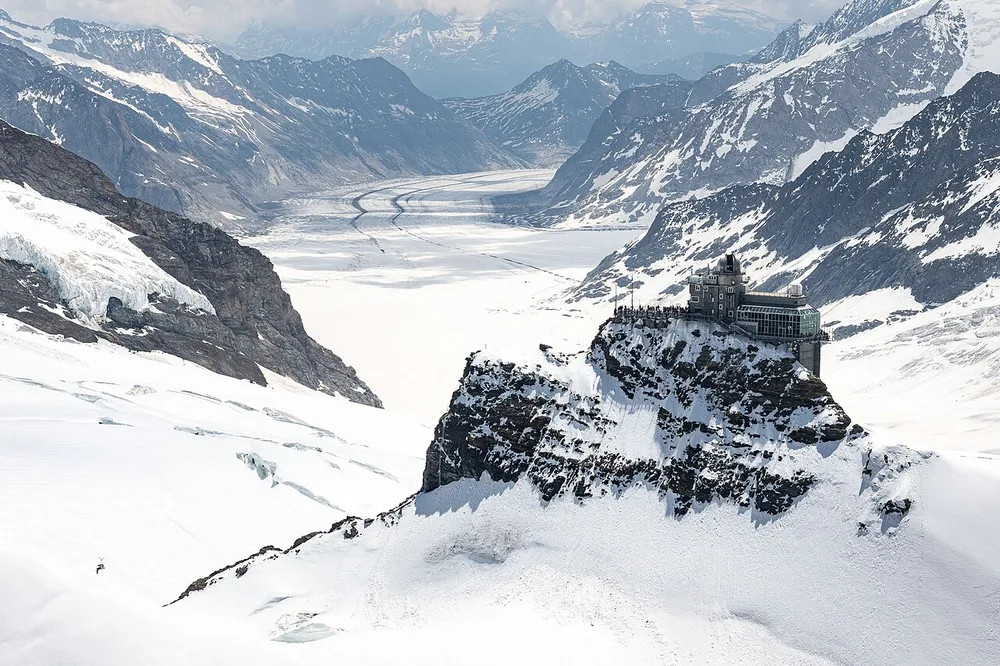

Jungfraujoch
The highest railway station in Europe at 3,454 m, with the longest glacier in the Alps below it. Expensive, weather-dependent, and worth doing properly.
The Jungfraujoch is the saddle between the Mönch and the Jungfrau, and the railway station cut into it at 3,454 metres is the highest in Europe. It is marketed as the Top of Europe, which is a stretch, and it is the single most expensive day out in Switzerland, which is not.
It is also genuinely extraordinary, and the whole area — Jungfrau-Aletsch — is a UNESCO World Heritage site. Below the terraces lies the Aletsch Glacier, the longest in the Alps: some 20 km of ice curving away south, with nothing man-made in sight.
Read this before you book
Go only in clear weather. This is the whole of the advice. In cloud you will pay a great deal of money to stand in a white room and see nothing, and the mountain makes its own weather regardless of what the valley is doing.
Check the live webcams at the summit the evening before and again at breakfast. If the top is in cloud, keep the day and go another time — that flexibility is worth more than any discount.
The other rules:
- Start early. From Zurich the round trip fills a whole day, and the last train down leaves in the middle of the afternoon.
- Dress for winter, whatever the month. It is below freezing up there in August, and there is snow year-round.
- Bring sunglasses. Sun on snow at 3,450 m is blinding, and altitude plus glare gives people headaches.
- Take altitude seriously. You go from 570 m to 3,454 m in a couple of hours. Move slowly at the top, drink water, and do not be surprised by breathlessness.
Getting there
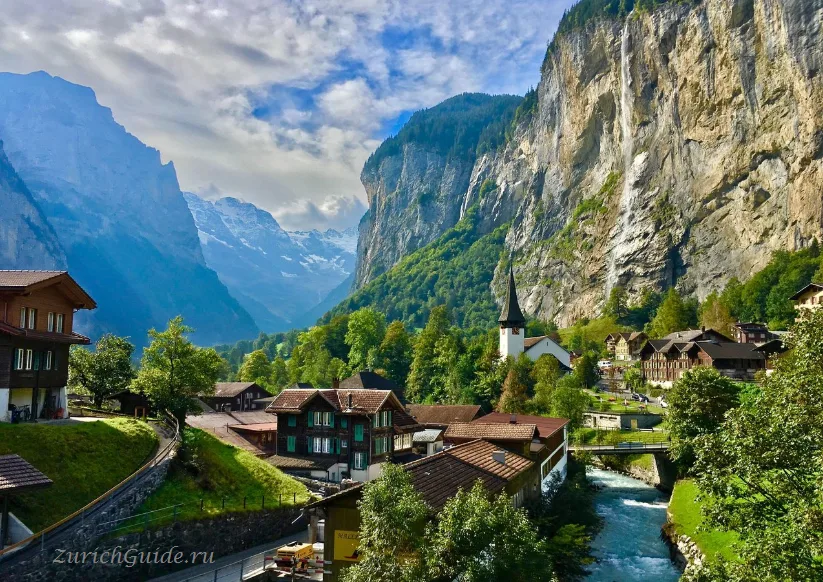
The journey is half the point. From Zurich allow four and a half to five and a half hours each way with the changes; from Interlaken Ost it is around two hours up.
The chain runs: Zurich → Bern or Lucerne → Interlaken Ost → Lauterbrunnen or Grindelwald → Kleine Scheidegg → Jungfraujoch.
Both middle branches work and both are beautiful, so a good plan is to go up one way and come down the other — Lauterbrunnen for its valley of vertical cliffs and seventy-odd waterfalls, Grindelwald for the Eiger standing over the village.
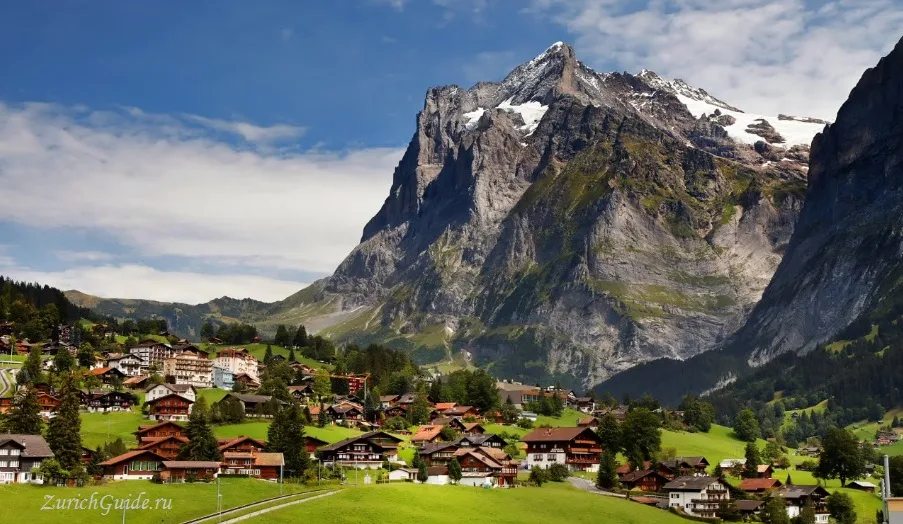
The Eiger Express changes the arithmetic
Since 2020 there is a gondola from Grindelwald Terminal to the Eiger Glacier station that cuts around 45 minutes off the old route each way. Most guidebooks — and the Russian original of this page — predate it.
Practically: go up via Grindelwald and the Eiger Express to save time in the morning, come down through Lauterbrunnen by rack railway for the scenery. Grindelwald Terminal has a large car park if you are driving that far.
The last stretch
From Kleine Scheidegg the Jungfrau Railway climbs into the mountain itself and spends most of the ascent inside a tunnel bored through the Eiger and the Mönch — an engineering project that took sixteen years and opened in 1912. The train pauses at Eismeer, where windows cut into the rock look out over a sea of crevasses.
Tickets
There is no cheap way up, but there are less expensive ways:
- Swiss Travel Pass and half-fare cards give a substantial reduction on the final section and cover the approach.
- The first train of the morning is discounted — the Good Morning ticket — provided you start down again before a set time. It also puts you at the top before the coaches arrive.
- Book online in advance in high season; the trains take reservations and they do sell out.
Fares change every year, so check the current ones on jungfrau.ch rather than trusting any figure written on a page like this.
What is actually up there
The station is a complex inside the rock, and you can spend two hours or twenty minutes:
- The Sphinx observatory terrace at 3,571 m, reached by lift, with the view over the Aletsch and, on a clear day, into France, Germany and Italy
- The Ice Palace — chambers and sculptures carved inside the glacier itself, several degrees below zero
- The Plateau — a snowfield you can walk out onto, roped off, with the Jungfrau above you
- The Alpine Sensation walkway, which tells the story of the railway’s construction and is more interesting than it sounds
- Restaurants, a chocolate shop, and the highest post box in Europe
In summer there is a short marked walk out across the glacier to the Mönchsjoch hut — an hour each way, at altitude, and only for people properly shod.
Is it worth it?
Honestly: if the weather is clear, yes. There is nowhere else in Europe where a train delivers you into high-alpine terrain like this, and the sight of the Aletsch from the terrace justifies the whole day.
If the weather is doubtful, there are cheaper mountains with the same view of the same peaks — Schynige Platte, Männlichen, First above Grindelwald — all a fraction of the price, all outdoors, and all better in mixed conditions.
Nearby
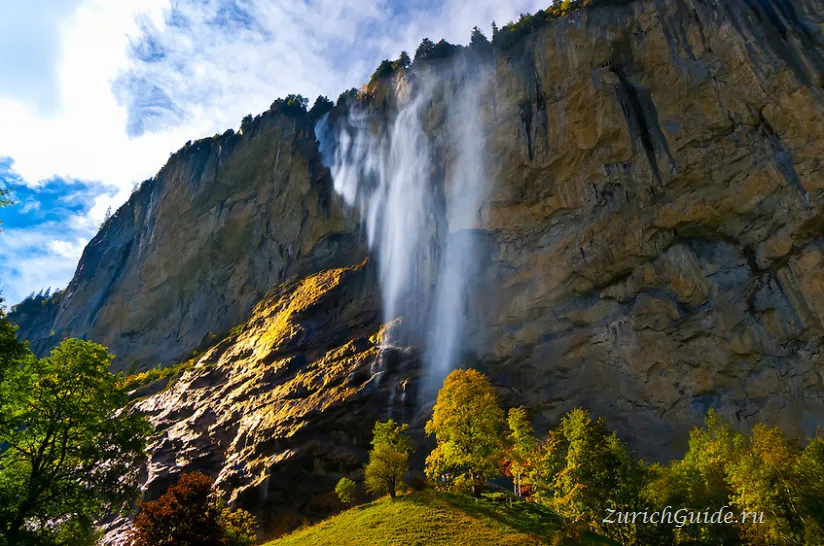
- Lauterbrunnen — the valley itself, with the Staubbach falling 300 m clear of the cliff, and the Trümmelbach falls inside the rock
- Grindelwald — the base under the Eiger, and the starting point for First
- Interlaken — between two lakes, and where every route through this region changes
- The ten most beautiful towns — Thun is at the end of the same lake
When to go
June to September for reliable trains and open trails below. Winter is quieter at the top and the light is better, but the approach can be disrupted and the days are short.
Any month: go on a clear day, and never book the ticket before you have looked at the sky.
Updated: