Interlaken
A town between two lakes that is not really a destination, and is the best base in Switzerland anyway.
Interlaken means between the lakes, and that is exactly what it is: a flat strip of land two kilometres wide separating Lake Thun from Lake Brienz, with the Eiger, Mönch and Jungfrau filling the horizon to the south.
Be clear about what it is for. Interlaken itself is a nineteenth-century resort town — a long main street of hotels, watch shops and adventure-sports agencies around a green field where paragliders land. Nobody comes for the town.
They come because everything in the Bernese Oberland connects here, and because it is where you sleep.
History
Organised tourism arrived in the early nineteenth century, when English-speaking artists and writers began coming for the scenery; better rail and steamer links then turned that trickle into a flood, and the visitor book is said to have included Mark Twain, Goethe, Wagner and Mendelssohn, along with a run of European royalty. Interlaken started as a summer-only resort and only later became a year-round one, as skiing gave it a winter season to match.
The two stations
This is the thing to get right before you book.
Interlaken Ost is the one that matters. Every mountain railway starts from it: Lauterbrunnen, Grindelwald, and on up to the Jungfraujoch. Both lake steamer piers are beside it. If you are going into the mountains, stay near Ost.
Interlaken West is closer to the shops and the main street.
They are 1.5 km apart, a fifteen-minute walk or three minutes by train, and confusing them costs you a connection. Trains from Bern and Lucerne serve both.
What to do in the town
Harder Kulm
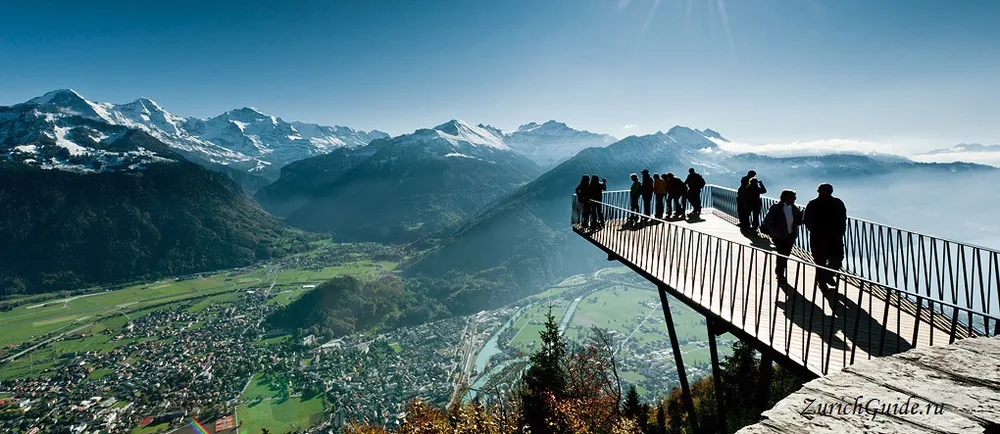
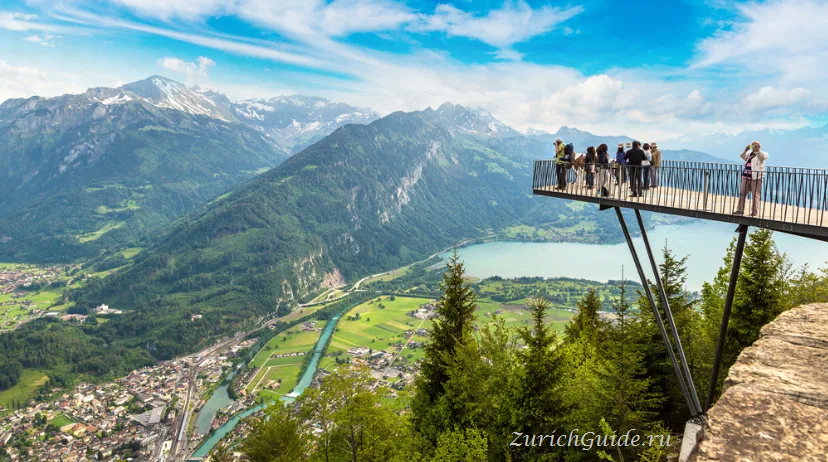
The obvious one, and a good one. A funicular climbs from near Interlaken Ost to 1,322 m in eight minutes, ending at a mock-castle restaurant and a viewing platform cantilevered out over the drop — both lakes below in their improbable turquoise, the town on its strip between them, and the three big peaks opposite.
It runs from spring to late autumn, and evening tickets let you stay for the sunset.
The Höhematte
The open field in the middle of town, kept clear by a covenant since 1864 — which is why the centre of Interlaken has a meadow in it rather than a shopping centre. Paragliders land here through the afternoon, having jumped off Beatenberg twenty minutes earlier.
The meadow began as the property of an Augustinian priory founded in 1130; the priory was dissolved during the Reformation, and part of its buildings survive at the edge of the meadow today. Interlaken’s hotel owners bought the site in the mid-nineteenth century and laid it out as parkland — the ancestor of the covenant that protects it now.
Unterseen
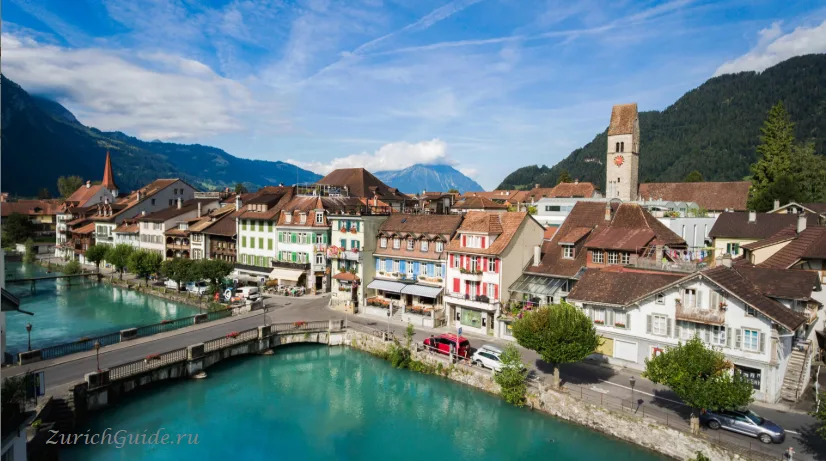
The old town most visitors never find, five minutes across the river from the main street: a medieval square, a church tower from 1471, and a row of houses along the Aare with the mountains behind. It is the one genuinely old thing in Interlaken and it takes twenty minutes to see.
The church tower is one of the most photographed views in the Bernese Oberland, with the Jungfrau rising to its right and the Mönch to its left.
Adventure sports
Interlaken is the paragliding, canyoning, rafting and skydiving capital of Switzerland, and half the main street sells it. Prices are similar between operators; safety records are not, so pick a long-established one rather than the cheapest flyer.
Interlaken is touristy enough that many shops will take euros alongside francs, and some stay open on Sundays, unlike almost everywhere else in Switzerland.
The lakes
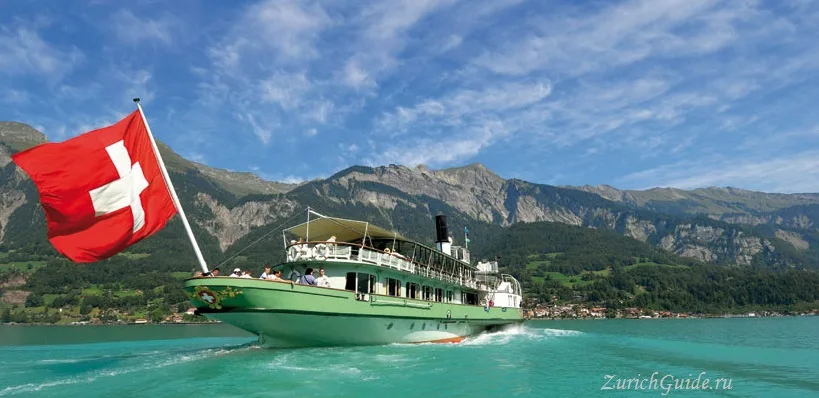
Both lakes have scheduled boats from piers beside Interlaken Ost, and both are covered by the Swiss Travel Pass — which makes them the cheapest good afternoon here.
Lake Brienz is the smaller and the more dramatic: steep sides, almost no development, and a colour that looks retouched. The Giessbach falls drop through fourteen stages beside a grand old hotel, reached by the oldest funicular in Europe from its own pier.
Lake Thun is broader and gentler, with castles along it — Spiez, Oberhofen on the water, and Thun itself at the far end.
Thun’s castle, above the old town, holds a small museum on the region’s history and gives a view over the lake from its windows.
St Beatus Caves
On the north shore of Lake Thun, about six kilometres from Interlaken, the St Beatus Caves are named after a hermit said to have lived in them in the sixth century — his grave is shown inside — and, before him, according to legend, a dragon. The show cave winds through stalactites, stalagmites and underground lakes, part of the route covered by boat, and stays close to 5°C year-round, so bring something warm. Visits are usually guided, though going through on your own is also possible. Outside the entrance there is a park with a restaurant, viewpoints over the adjoining waterfall, and a small museum of minerals.
Brienzer Rothorn
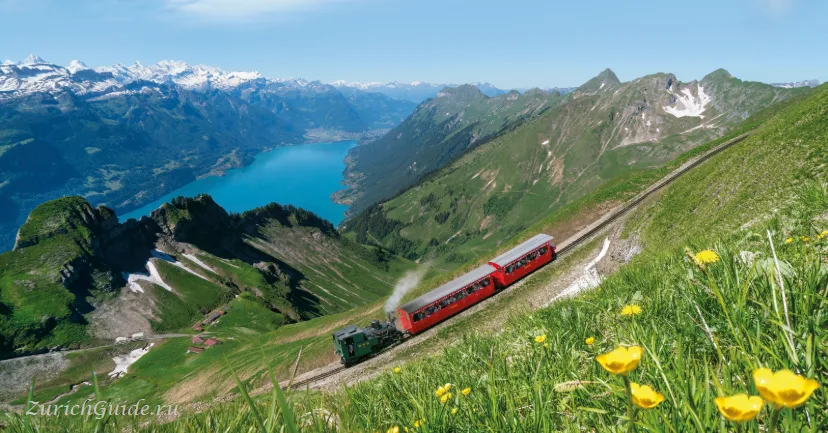
From Brienz, at the far end of the lake, the last steam-operated rack railway in Switzerland climbs to 2,244 m in an hour, still running on coal and oil-fired locomotives from the 1890s. It is a slow, sooty, entirely delightful piece of machinery, and the view at the top runs the whole length of the lake.
What Interlaken puts within reach
This is the actual case for staying here:
- Jungfraujoch — two hours up, the Top of Europe
- Lauterbrunnen — twenty minutes, the valley of waterfalls
- Grindelwald — thirty minutes, under the Eiger
- Wengen, Mürren, Schilthorn — the car-free shelves above Lauterbrunnen
- Schynige Platte — an old rack railway to an alpine garden, and the cheap alternative to the Jungfraujoch on a clear day
- Meiringen — under an hour along Lake Brienz; reputed birthplace of the meringue, and the village Conan Doyle chose for Sherlock Holmes’s fictional death at the nearby Reichenbach Falls, with a small museum devoted to him
- Bern — under an hour
Getting there
- By train — Zurich about two hours via Bern or Lucerne; Bern under an hour; Lucerne about two hours on the scenic Brünig line.
- By panoramic train — Interlaken is the mid-point of the GoldenPass between Lucerne and Montreux.
- By car — possible, and unnecessary. Everything above is reachable by rail, and the mountain villages are car-free anyway.
- The Lucerne-bound GoldenPass leg runs hourly from Interlaken Ost, follows Lake Brienz to Meiringen — a natural place to break the journey for the Reichenbach Falls — and then crosses the passes; no seat reservation is required, and the Swiss Travel Pass and day tickets are valid.
- With only a single day, an organised day tour stringing together several places at once — Thun, Grindelwald, the waterfall valleys, Reichenbach Falls — can cost close to the train fare alone and cover more ground than doing it yourself by rail.
- Regional passes covering multi-day travel across the Bernese Oberland, with discounts further afield toward Lucerne or Montreux, are worth pricing against your itinerary before buying single tickets — see tickets and passes.
When to go
June to September for the mountains, when everything runs and the high paths are clear. December to March for skiing, with Grindelwald and Wengen twenty minutes away.
April, May and November are the awkward months: the lower valley is green but a good share of the mountain railways shut for maintenance. Check what is running before booking, because Interlaken without its connections is just a street of hotels.
Prices track the season closely: January and February are the cheapest time to visit, midsummer the most expensive. Winter skiers based here also tend to find better rates than at the resorts themselves, since Interlaken fills up on its own summer schedule rather than the ski season’s.
Where to park in Interlaken
| Car park | Spaces | Fee | From centre |
|---|---|---|---|
| Parkhaus Zentrum Interlaken underground | 115 | paid | 170 m |
| Rosenpark | 90 | paid | 360 m |
| Auditorium Ost | 26 | paid | 360 m |
| Casino Kursaal West | 80 | paid | 380 m |
| Casino Kursaal Ost | 50 | paid | 410 m |
| Strandbadstrasse | 100 | paid | 420 m |
| Bärenparking Interlaken AG underground | — | paid | 450 m |
| Haberdarren | — | paid | 650 m |
10 more are mapped nearby — see them on OpenStreetMap.
Data © OpenStreetMap contributors, ODbL licence, snapshot of 22 August 2026. The map is drawn by volunteers: the list is not complete, and a dash means “not recorded” — not “free” and not “no spaces”. This is not an official parking directory: when you get there, read the signs and the machine at the entrance.
Weather in Interlaken month by month
| Month | Day | Night | Rainfall |
|---|---|---|---|
| January | +3° | -3° | 72 mm |
| February | +6° | -2° | 67 mm |
| March | +11° | +1° | 73 mm |
| April | +15° | +4° | 82 mm |
| May | +19° | +8° | 122 mm |
| June | +23° | +12° | 127 mm |
| July | +24° | +14° | 146 mm |
| August | +24° | +14° | 146 mm |
| September | +19° | +10° | 94 mm |
| October | +14° | +6° | 80 mm |
| November | +8° | +1° | 80 mm |
| December | +4° | -2° | 91 mm |
Normals for 1991–2020 from MeteoSwiss, station Interlaken, open data, version of 29 July 2026. Day and night are the average daily high and low, not records; rainfall is approximate. Current conditions from the Norwegian Meteorological Institute, CC BY 4.0.
Updated: