Geneva
Switzerland's second city, wedged into the French border at the end of the lake, and the one everybody mistakes for the capital.
Geneva is not the capital of Switzerland. Bern is — a fact that surprises a remarkable number of visitors, and one worth getting out of the way first.
What Geneva is instead: the second-largest city in the country, at the far western tip of it, pushed so hard against the French border that France surrounds it on three sides. The lake begins here and the Rhône leaves here, and on a clear day Mont Blanc stands at the end of the water.
It is also the most international place in Switzerland. The UN’s European headquarters, the Red Cross, the WHO, the WTO and around 40 other organisations sit in one quarter north of the station, and CERN is out by the French frontier. Roughly two in five residents hold a foreign passport, and you will hear more English and French than Swiss German.
Getting in from the airport — free
Geneva airport is six minutes by train from the main station, Cornavin — one of the shortest airport runs in Europe.
The useful part: there is a machine in the baggage hall that dispenses a free ticket valid for 80 minutes on Geneva public transport, which covers the trip into town. Take one before you leave the baggage area. Almost nobody who has not been told about it finds it.
If you are staying in a hotel, hostel or campsite in the city, you will also be given a Geneva Transport Card at check-in, covering buses, trams and boats for the length of your stay. Ask for it; it is not always offered.
Finding your way
The one thing to know before arriving: the old town is not next to the station. Cornavin sits on the right bank; the old town is up the hill on the left bank, 15 to 20 minutes on foot across the river, or a few stops by tram.
The city divides into four pieces you will actually use:
- Rive droite — the station, the international quarter, the big hotels
- Rive gauche — the lake front, the shopping streets, and the hill
- Vieille Ville — the old town on top of that hill
- Les Pâquis — behind the station, the cheap and lively quarter, and where to eat
What to see
The Jet d’Eau
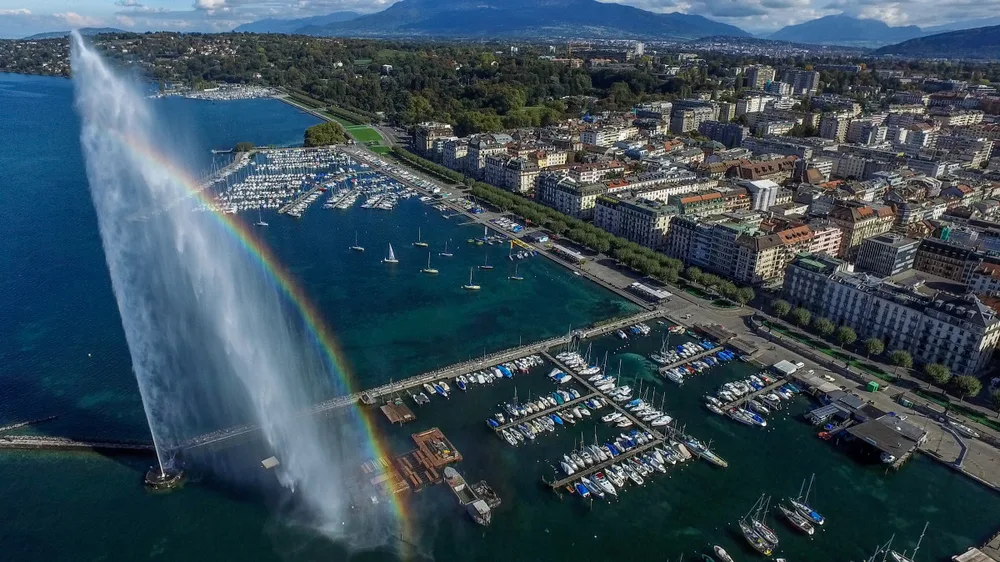
The fountain in the harbour throws water 140 metres into the air at around 200 km/h, using half a tonne of water a second. It began life in 1886 as a pressure-release valve for the city’s hydraulic network and was kept because people liked looking at it.
You can walk out along the jetty and stand under it. You will get wet, and that is rather the point.
Vieille Ville
The old town is compact, steep and genuinely old — the largest historic centre in Switzerland.
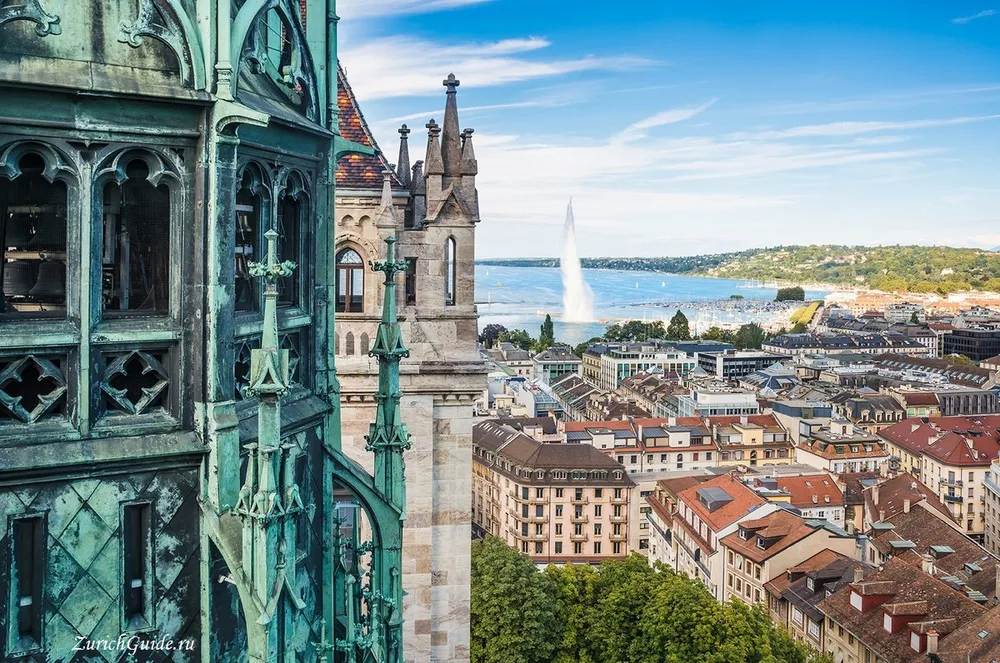
Cathédrale Saint-Pierre is the centre of it: twelfth-century, stripped bare in the Reformation, and the church from which John Calvin preached for over twenty years. His chair is still there. Two things are worth the extra ticket — the archaeological site underneath, where excavation exposed a Roman sanctuary and four earlier churches stacked in sequence, and the tower climb for the view over the roofs to the lake.
Place du Bourg-de-Four is the oldest square, a former Roman market and the place to sit outside. Maison Tavel nearby is the oldest house in the city and now a free museum of Geneva itself.
The Reformation Wall
A hundred metres of stone in the Parc des Bastions, carved in 1909 with four figures five metres tall — Calvin, Farel, Bèze and Knox — and panels of the Reformation across Europe. Whatever you think of the theology, it is a serious monument, and the giant chess boards in front of it are a Geneva institution.
The international quarter
Palais des Nations — the UN’s European headquarters, in the buildings the League of Nations left behind. Guided tours run most weekdays; bring a passport. Outside stands the Broken Chair, a twelve-metre wooden chair with one leg blown off, put there as a protest against landmines.
The Red Cross and Red Crescent Museum across the road is the better visit of the two: a serious, well-made museum about the movement’s history and about what happens to people in war.
The lake
Boats leave the quays for short round trips and for the run down to Lausanne, Vevey and Montreux. In summer the Bains des Pâquis — a public bathing pier on the right bank — is where Geneva swims, eats fondue in winter, and watches the sunset for a couple of francs.
What it costs
Geneva is expensive even by Swiss standards — regularly in the top three cities in the world for cost of living.
The usual defences apply: supermarket lunches, tap water from the fountains, fixed-price lunch menus. One local trick: France is a tram ride away, and Genevans cross the border to do their shopping. If you have a car, or are near the border, the price difference is dramatic.
What to eat
The cooking is French-leaning, and the local specialities are worth knowing:
- Filets de perche — lake perch, fried, with tartare sauce and chips. The dish of the region.
- Longeole — a coarse Geneva sausage with fennel seed, cooked slowly.
- Fondue — this is the French-speaking side, so it is served properly and eaten seriously.
- Marmite de l’Escalade — a chocolate cauldron filled with marzipan vegetables, sold in December only, and smashed with a fist while reciting a line about the enemies of the Republic.
L’Escalade
Geneva’s own festival, on the weekend nearest 11 December, marks the night in 1602 when the Duke of Savoy’s men tried to scale the walls and failed. The city turns out in seventeenth-century costume, torches and all, and a woman called Mère Royaume is remembered for emptying a cauldron of hot soup onto the attackers — hence the chocolate cauldrons.
It is the one time of year Geneva stops being solemn, and it is worth planning a trip around.
Around Geneva
- Lavaux — the UNESCO vineyard terraces, an hour along the lake
- Lausanne — 35 minutes by train, with a cathedral and the Olympic Museum
- Montreux and Chillon — an hour, for the castle on the water
- Chamonix and Mont Blanc — an hour and a half into France
- Annecy — 45 minutes into France, and one of the prettiest towns in the Alps
When to go
May to September for the lake and the boats. December for L’Escalade and the Christmas markets. The city is at its least appealing in a grey January, when the bise — the north wind that funnels down the lake — makes it feel considerably colder than the thermometer says.
Where to park in Geneva
| Car park | Spaces | Fee | From centre |
|---|---|---|---|
| Saint-Antoine | 406 | — | 380 m |
| Mont-Blanc | 1,383 | — | 380 m |
| Uni-DUFOUR | 157 | — | 410 m |
| Place des Casemates | 18 | — | 420 m |
| Plaine de Plainpalais | 703 | — | 590 m |
| Rive-Centre | 547 | — | 600 m |
| MANOR | 281 | — | 610 m |
| Square du STAND | 185 | — | 640 m |
39 more are mapped nearby — see them on OpenStreetMap.
Car park data — SITG / République et canton de Genève, cantonal open data, version of August 2026. This is not an official parking directory: when you get there, read the signs and the machine at the entrance.
Weather in Geneva month by month
| Month | Day | Night | Rainfall |
|---|---|---|---|
| January | +6° | -1° | 63 mm |
| February | +8° | -1° | 54 mm |
| March | +13° | +1° | 63 mm |
| April | +17° | +4° | 76 mm |
| May | +21° | +9° | 89 mm |
| June | +25° | +12° | 87 mm |
| July | +28° | +14° | 83 mm |
| August | +27° | +14° | 88 mm |
| September | +22° | +10° | 96 mm |
| October | +16° | +7° | 98 mm |
| November | +10° | +2° | 88 mm |
| December | +6° | 0° | 82 mm |
Normals for 1991–2020 from Météo-France, station GAILLARD, Licence Ouverte 2.0, version of 7 August 2026. Day and night are the average daily high and low, not records; rainfall is approximate. Current conditions from the Norwegian Meteorological Institute, CC BY 4.0.
Updated: