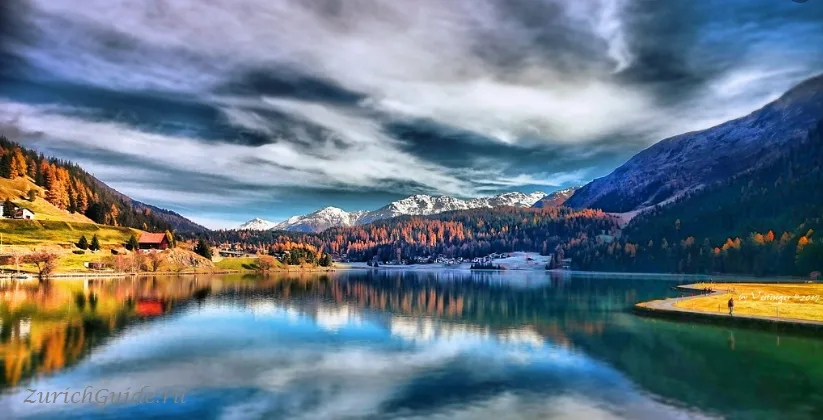
Davos and Klosters
The highest town in Europe, built as a tuberculosis cure and rebuilt as five ski areas, with a January conference that shuts the whole place.
Davos sits at 1,560 m in Graubünden and is the highest town in Europe. It does not look like a Swiss resort — it looks like a small city stretched along a valley floor, because that is what it became.
It grew as a tuberculosis cure. From the 1860s doctors sent patients to the dry, thin, sunny air here, and the town filled with sanatoria: long balconied buildings where people lay wrapped in blankets for years at a time. Thomas Mann’s wife was a patient, he visited in 1912, and The Magic Mountain came out of it.
Davos drew more than patients. Robert Louis Stevenson spent a tubercular winter here in 1882, and Arthur Conan Doyle, in Davos in 1894–95, is by his own account the first person to have skied down from the peaks above the town.
When antibiotics ended the cure trade in the 1950s, the sanatoria became hotels and the town became a ski resort.
Much of the old sanatorium infrastructure is gone, but the town still runs a high-altitude training centre that ranks, by reputation, among the best in the world, used by endurance athletes preparing for competition.
The skiing
Five separate areas, which is what makes Davos-Klosters one of the largest ski regions in Switzerland:
Parsenn — the big one, shared with Klosters, with long descents including the famous run down to Küblis, 12 km and 2,000 vertical metres. Jakobshorn — the snowboarders’ mountain, with the noisiest après-ski. Rinerhorn and Pischa — quieter, family-oriented. Madrisa, above Klosters — sunny and gentle.
Klosters itself is the smaller, prettier village down the valley, historically the British royal family’s resort and considerably more restrained than Davos.
Across the linked areas there are around 320 km of marked piste on 99 runs, roughly half of it graded intermediate (red), a third for beginners (blue) and the rest for experts (black).
The Parsennbahn funicular, leaving from Davos Dorf, climbs towards Weissfluhjoch at the centre of the Parsenn area; a second, smaller funicular, the Schatzalpbahn, runs up from Davos Platz to the Schatzalp, from where chairlifts continue higher. Off the slopes there is an indoor pool, an ice rink, sledging, snowshoeing and tandem paragliding.
Summer
Davos works better in summer than its winter reputation suggests. There are around 700 km of marked paths, the lake is warm enough to swim in by August, and the Schatzalp — a former sanatorium, reachable by funicular, and the model for the one in The Magic Mountain — has an alpine botanical garden with several thousand species.
The Jöriseen, a group of high blue lakes above the Flüela pass, are the classic day walk.
Hiking
On foot, the climb from the valley to Weissfluhjoch takes three to four hours; the Parsennbahn covers the same ground for anyone who would rather ride up. From the top, the panorama takes in Piz Buin and the surrounding ranges. A chairlift continues from the funicular’s upper station to the very summit for a wider view still; from there it is roughly two hours down to Davos, four to Klosters, and about six to Arosa.
A harder route runs from Gotschnagrat by way of Casanna Alp and Serneuser Schwendi down into Klosters, around three hours in total. Easier walking stays low, looping the small lake at the edge of town.
The botanical garden above the Schatzalp is known as the Alpinum; the path up from the top of the Schatzalpbahn reaches it directly, and it opens roughly from May to October. Also popular in summer: tandem paragliding, curling, rollerblading, swimming, volleyball, windsurfing, golf and riding.
Kirchner
Ernst Ludwig Kirchner, the Expressionist, came to Davos in 1917 to recover from a breakdown after military service and stayed for the rest of his life. The mountains changed his painting completely — the harsh Berlin street scenes gave way to alpine landscapes in extraordinary colour.
The Kirchner Museum holds the largest collection of his work anywhere. He killed himself here in 1938, shortly after the Nazis condemned his work as degenerate.
The museum building itself is worth a look: a series of interlinked cubes with translucent glazing that diffuses the daylight inside. Davos also has a small Wintersportmuseum, given over mainly to the history of skiing in the resort.
Festivals
The Davos Festival runs from late July to mid-August, mixing classical concerts with contemporary performances, and is preceded by a week of jazz.
The World Economic Forum
Every January, for about five days, Davos hosts the WEF and becomes a fortified enclave: several thousand delegates, road closures, snipers on roofs, and hotel prices that multiply by ten.
Do not plan a holiday for that week. The dates are published a year ahead.
Getting there
- By train — Zurich about two and a half hours via Landquart; Chur an hour and a quarter. The line up from Landquart is the Rhaetian Railway and is a scenic route in its own right.
- From Klosters the Vereina tunnel carries a car shuttle through to the Engadin, which stays open when the passes are shut; see driving in Switzerland.
- Davos sits on a single branch line off Landquart, so the last stretch of any approach, from anywhere, is the same one change.
- From Zurich Airport allow around two and three-quarter hours, changing at Zurich HB and again at Landquart, which has a well-known outlet village if there’s time to spare.
- From Geneva Airport the journey is long and impractical, around five and a half hours with two changes. From Basel Airport it takes under four hours, and the Swiss Transfer Ticket is worth using on that route. Either way, Zurich remains the more practical gateway.
- The graubündenPASS gives free travel on regional public transport across part or all of Graubünden, plus discounts on some mountain railways; see tickets and passes.
Getting around
Davos runs between two stations, Davos Dorf and Davos Platz, about 4 km apart, linked by the Promenade, the main street of shops and hotels. Traffic on it runs one-way towards Platz; the quieter Talstrasse takes the other direction. Most of the nightlife is around Platz.
Davos Platz is the main station, but trains towards Klosters and Landquart call at Davos Dorf instead, and there are also direct buses to Chur. VBD town buses serve the sights around Davos and are free to Guest Card holders. Tourist offices are on the Promenade in Platz and by the Dorf station.
The valley is ringed by peaks: Weissfluh (2,844 m) to the north, Strelagrat (2,545 m) and Schwarzhorn (2,670 m) on the flanks, and Jakobshorn (2,590 m) to the south.
When to go
December to April for skiing, July to September for walking. Avoid the WEF week in January.
May and November are the shoulder months when the town largely closes.
Where to park in Davos and Klosters
| Car park | Spaces | Fee | From centre |
|---|---|---|---|
| Parkhaus Arkaden Davos underground | — | paid | 110 m |
| Postplatz | — | paid | 380 m |
| Parkhaus Silvretta underground | — | paid | 500 m |
| Parkplatz Jakobshornbahn | — | paid | 560 m |
| Underground car park | — | paid | 710 m |
| Kongress | — | paidmax 10 h | 740 m |
| Horlauben | — | paidmax 2 h | 880 m |
| Parkhaus Migros underground | 167 | paid | 950 m |
Data © OpenStreetMap contributors, ODbL licence, snapshot of 22 August 2026. The map is drawn by volunteers: the list is not complete, and a dash means “not recorded” — not “free” and not “no spaces”. This is not an official parking directory: when you get there, read the signs and the machine at the entrance.
Weather in Davos and Klosters month by month
| Month | Day | Night | Rainfall |
|---|---|---|---|
| January | 0° | -9° | 70 mm |
| February | +2° | -9° | 52 mm |
| March | +5° | -5° | 57 mm |
| April | +9° | -2° | 54 mm |
| May | +13° | +3° | 89 mm |
| June | +17° | +6° | 129 mm |
| July | +19° | +8° | 133 mm |
| August | +19° | +8° | 150 mm |
| September | +15° | +4° | 96 mm |
| October | +11° | +1° | 77 mm |
| November | +5° | -4° | 71 mm |
| December | +1° | -7° | 68 mm |
Normals for 1991–2020 from MeteoSwiss, station Davos, open data, version of 29 July 2026. Adjusted to the elevation of the place. Day and night are the average daily high and low, not records; rainfall is approximate. Current conditions from the Norwegian Meteorological Institute, CC BY 4.0.
Updated: