Brienz and Ballenberg
A village of woodcarvers on a turquoise lake, with the last steam rack railway in Switzerland above it and a hundred historic farmhouses next door.
Brienz sits at the eastern end of its lake, twenty minutes from Interlaken, and has three things worth the journey: a steam railway, an open-air museum, and a woodcarving tradition that is still a working trade rather than a souvenir industry.
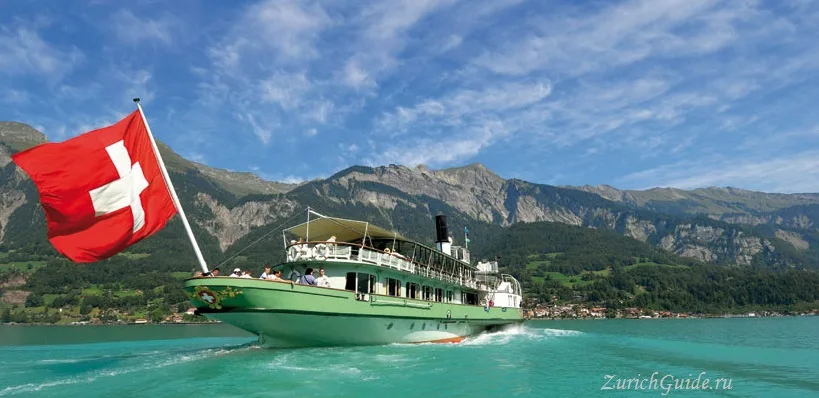
The lake itself is the other reason — Brienzersee is steep-sided, almost undeveloped and an improbable turquoise from the glacial flour suspended in it.
Green mountains hem the lake in on both sides and feed it with streams off their slopes: Faulhorn (2,681 m) to the south, Brienzer Rothorn (2,350 m) to the north-east. Brienzersee is often rated among the cleanest lakes in Switzerland. The village itself sees a fraction of the crowds that head for Interlaken along the shore.
Brienzer Rothorn
The last steam-operated rack railway in Switzerland, climbing from the lakeshore to 2,244 m in about an hour on coal- and oil-fired locomotives, some of them from the 1890s.
It is slow, sooty and entirely delightful, and at the top the view runs the whole length of the lake with the Bernese Alps opposite. Runs roughly June to October, weather permitting, and it sells out on fine summer days — book.
The line starts at the lakeshore, 566 m above sea level, so the climb covers close to 1,700 vertical metres in the hour. A network of hiking paths fans out from the top station for those who want to walk back down.
Ballenberg
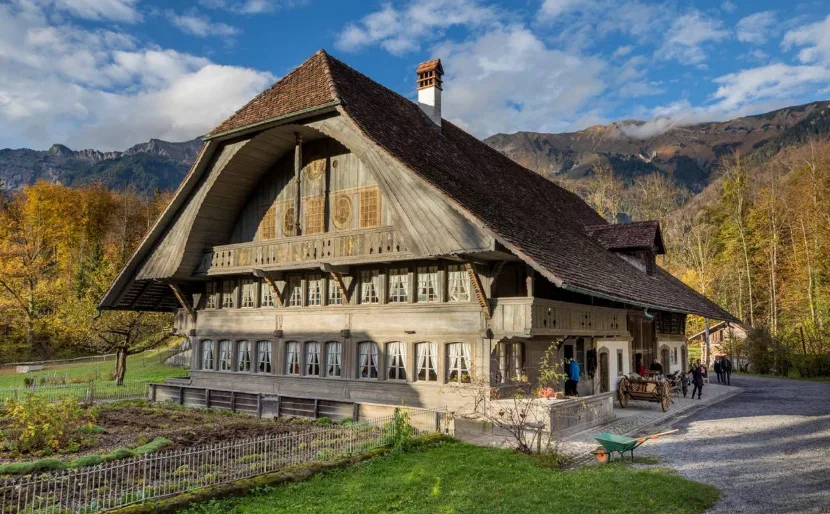
The Swiss Open-Air Museum, a short bus ride from the village, and better than the description suggests.
More than a hundred rural buildings from every part of the country have been dismantled where they stood, moved here and rebuilt: farmhouses, barns, a sawmill, a cheese dairy, a chapel, each with the garden, livestock and field boundaries appropriate to it. The site covers 66 hectares and the buildings are grouped by region, so walking across it is walking across Switzerland.
There are craftspeople working — a blacksmith, a weaver, a basket-maker, a cheesemaker — and the animals are old breeds. Allow half a day; it is far larger than it looks on the map.
The site has two entrances at opposite ends — one near Brienz, the other close to Brienzwiler a few kilometres to the east — and buses run from the village to both. The buildings are grouped into thirteen zones by region, and there are places to eat inside, along with shops selling meat and charcoal for the museum’s barbecue grills.
Open roughly mid-April to end of October.
The woodcarvers
Brienz has carved wood since the early nineteenth century, when the trade was developed deliberately to give the valley an income beyond farming. The Schnitzlerschule is still the national school for it, and there is a violin-making school here too.
The shops in the village sell the real thing alongside the tourist version, and the difference in price tells you which is which.
The carvings range from simple mass-produced pieces to individually worked scenes of traditional rural life and figures of people and animals; the workshops behind the school produce the best of it.
Giessbach
Across the lake, reachable by boat, the Giessbach falls drop through fourteen stages beside a grand nineteenth-century hotel. The funicular up from the boat pier, built in 1879, is the oldest public funicular in Europe.
The path behind the falls gets you wet and is free.
The falls are on the far shore, near the village of Iseltwald; the hotel above them is the Grandhotel Giessbach.
Lake cruises
Boats cover the length of the lake from April to October, more often in high summer than in spring and autumn. Some are themed: a breakfast run between Interlaken and Brienz, a lunch cruise serving fish caught in the lake, and, in autumn, a fondue cruise with traditional music. All of these need a seat booked in advance.
Eating
Most restaurants sit on the main street, and fresh fish from the lake appears on nearly every menu.
Finding your way
The tourist office is on the main street, close to the boat pier and facing the railway station, with the valley terminus of the Rothornbahn a short walk from both.
Getting there
- By train — Interlaken Ost 20 minutes on the Brünig line; Lucerne an hour and a quarter. This is the GoldenPass route.
- By boat — from Interlaken Ost along the lake, about an hour and a quarter, and much the better arrival. Covered by rail passes; see the lakes.
- By road — the Brünig pass road runs east past Meiringen and the Reichenbach falls to Lucerne; the lakeside road runs west to Interlaken and Lake Thun.
- From Zurich — around two and a half hours each way, changing at Bern or at Lucerne, with several trains an hour.
- Onward from Interlaken Ost — trains continue to Grindelwald, Lauterbrunnen and Jungfraujoch, marketed as the highest railway station in Europe.
- A regional pass, the Tell-Pass, covers public transport around Lucerne, including this line, for a fixed run of days; see tickets and passes.
When to go
June to October, when the Rothorn railway runs and Ballenberg is open. Outside that the village is quiet and both are shut.
Combine with Meiringen and the Aare gorge, fifteen minutes further up the valley.
Meiringen is also where the Reichenbach Falls drop through the rock face — the setting Arthur Conan Doyle chose for Sherlock Holmes’s final struggle with Moriarty. An old funicular climbs from the town to the foot of the falls; the flow is heaviest in spring, when the snow above is melting, and the best view is a further short walk above the funicular’s top station.
Where to park in Brienz and Ballenberg
| Car park | Spaces | Fee | From centre |
|---|---|---|---|
| Fischerbrunnenplatz | — | — | 200 m |
| Parkgar underground | — | — | 200 m |
| Bärenplatz | — | — | 210 m |
| Rössliplatz | — | paid | 230 m |
| Wiesplatz | — | — | 310 m |
| Löwenplatz | — | — | 400 m |
| Rothorn Parkplatz rooftop | 72 | paid | 480 m |
| Chilchen | — | paid | 480 m |
5 more are mapped nearby — see them on OpenStreetMap.
Data © OpenStreetMap contributors, ODbL licence, snapshot of 22 August 2026. The map is drawn by volunteers: the list is not complete, and a dash means “not recorded” — not “free” and not “no spaces”. This is not an official parking directory: when you get there, read the signs and the machine at the entrance.
Weather in Brienz and Ballenberg month by month
| Month | Day | Night | Rainfall |
|---|---|---|---|
| January | +2° | -5° | 82 mm |
| February | +5° | -4° | 72 mm |
| March | +10° | 0° | 85 mm |
| April | +15° | +3° | 90 mm |
| May | +19° | +7° | 137 mm |
| June | +22° | +11° | 148 mm |
| July | +24° | +13° | 160 mm |
| August | +23° | +12° | 174 mm |
| September | +19° | +9° | 108 mm |
| October | +14° | +5° | 92 mm |
| November | +8° | 0° | 95 mm |
| December | +3° | -4° | 98 mm |
Normals for 1991–2020 from MeteoSwiss, station Meiringen, open data, version of 29 July 2026. Day and night are the average daily high and low, not records; rainfall is approximate. Current conditions from the Norwegian Meteorological Institute, CC BY 4.0.
Updated: