Baden
The hottest and most mineral-rich springs in Switzerland, used since the Romans, with a new bath house and a small old town under a ruined castle.
Baden is twenty minutes from Zurich, and it sits on the hottest and most mineral-rich springs in Switzerland — water emerging at around 47 °C with a mineral content several times that of any other Swiss spa.
The Romans built baths here in the first century and called the place Aquae Helveticae. It has been in the bathing business, with interruptions, ever since.
History
The Swiss Confederation took Baden in 1415, and once the rest of Aargau had fallen too, the confederates met here to settle the government of the new territory — in effect making the town the Confederation’s meeting place from 1426 until 1712, its diet sitting in the Rathaus. A treaty signed in Baden in 1714 ended the war between France and the Holy Roman Empire. Between 1798 and 1803, after the upheavals of the Helvetic Republic, Baden was briefly the capital of its own small canton, before the larger Aargau was formed around it.
The town had already been a fashionable spa for centuries by then, drawing visitors through the fifteenth and sixteenth centuries; later regulars included Goethe, Nietzsche, Thomas Mann and Hermann Hesse.
The baths
The spa quarter went into a long decline through the twentieth century, and for years the springs ran with almost nothing built over them.
Fortyseven — named for the temperature — opened in 2021 to a design by Mario Botta, and put a proper bath house back into the town: a cluster of stone-clad volumes stepping down to the Limmat, with indoor and outdoor pools, a sauna area and views over the river.
It is the closest serious thermal bath to Zurich and reachable on an ordinary train ticket, which makes it the obvious wet-weather answer for anyone staying in the city. See thermal baths.
The name itself is simply the German word for bathing. Nineteen sulphurous springs feed the town, water credited locally with easing rheumatism, respiratory and cardiovascular complaints, and some neurological conditions. Several of the older hotels still run their own pools, generally open to non-guests for a fee, alongside the newer bath house.
The old town
Small, stepped and largely intact, on a bend of the Limmat under a rocky spur.
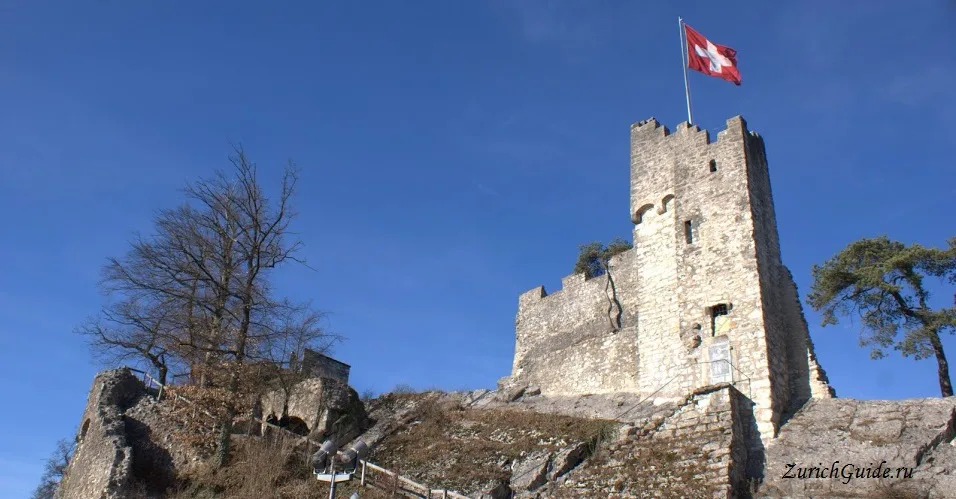
The Holzbrücke, a covered wooden bridge, crosses the river to the spa side. Above the town stand the ruins of Stein castle, blown up by the Bernese in 1415 and left as a shell with the view over the roofs.
The Landvogteischloss on the far bank was the seat of the Confederation’s bailiff for the county of Baden, which for three hundred years was jointly ruled territory — several cantons administering one district together, and the diet of the old Confederation met here.
The Museum Langmatt, in a villa, holds a good collection of French Impressionists — Renoir, Cézanne, Degas — assembled by an industrialist family.
The castle above the town was probably founded in the eleventh century by the counts of Lenzburg, passing to the counts of Kyburg in 1172 and to the Habsburgs in 1264, whose bailiff used it as an official residence through the fourteenth century. Only the watchtower and a small chapel survive; the tower was opened to visitors after a 1947 restoration, and further safety work in 1996 shored up the bastion walls and vaulted cellars. The chapel of St Nicholas, on the same summit, is first recorded in 1346, survived the castle’s destruction in 1415, and was rebuilt to its present Baroque form in 1712.
The Landvogteischloss guarded a narrow passage between the Schlossberg and the Lägern, the easternmost ridge of the Jura, on the border between the cantons of Zurich and Aargau. Its rubble-stone core dates from the first half of the twelfth century; later rebuilding over several centuries left it with a markedly irregular plan. The museum’s displays run from the Roman period to the present, including the story of the baths and of the industry that followed them.
The brick-red Rathaus, where the city council still sits, hosted the most important sessions of the old Confederation’s diet through Baden’s centuries as a shared capital, and has been a heritage site of national significance since 1995. It dates from about 1360; its east front, facing the Limmat, carries an elaborate painted clock of 1599 flanked by allegorical figures of Justice and Nemesis. Around it stand the ochre Stadthaus, now the city administration; the Zeughaus of 1614, a Renaissance arsenal with two lions holding an orb and sword over its door; the stepped-gabled Stadtkanzlei, seat of the city council; and the late-Gothic Amtshaus, refronted in the nineteenth century.
At the north end of the upper town stands the Stadtturm, the only surviving tower of the medieval wall, built in two stages in the fifteenth century: a three-storey base in 1441–48, during a war between Zurich, then still outside the Confederation, and the rest of it, and a taller top with four corner turrets and two bells in the early 1480s. Its tiled roof is painted in the city’s colours of black, red and white, and it served as the town prison until 1985. Below it, where Rathausgasse and Weite Gasse meet the approach to the Kirchplatz, stands the Löwenbrunnen, a sandstone fountain of 1822 topped since 1918 by a lion snarling at the tower, its back turned on the Catholic church.
That church, the Stadtpfarrkirche Maria Himmelfahrt, is Gothic in its present form, built in 1457–60 under the master builders Hans Murer and Cunrat Zobrist, with the tower added some decades later; the parish itself is far older, tracing through a Romanesque predecessor to a first church recorded in the ninth century. Its small neighbour, the Sebastianskapelle, was finished in 1509 on the site of an abandoned crypt, built by the same Hans Murer. Down by the wooden bridge, the Kornhaus is the town’s old grain store, put up in 1511 for the hospital of St Agnes and later used as Baden’s communal granary, then briefly a barracks and a prison workshop; its cellar has held a small theatre since the 1950s.
The covered bridge itself is 39 metres long, rebuilt in 1810 on piers left from its seventeenth-century predecessor. A life-size sandstone statue of St John of Nepomuk stands at its western end, dated 1707 and the only sizeable Baroque sculpture in the town — though it is a copy, the original being kept in the Landvogteischloss museum.
The industry
Baden is also where Brown, Boveri & Cie was founded in 1891, which became ABB and made the town, for a long period, one of the centres of European electrical engineering. The industrial quarter has been converted rather than demolished, and there is a good deal of early-modern architecture if you look.
Further afield
A short way beyond the old town lie further sights. Schloss Lenzburg, the oldest and best known hilltop castle in Switzerland, houses the historical museum of the canton of Aargau. Königsfelden Convent, founded after the death of the German king Albrecht I by his widow, is known for its stained glass, and Wettingen’s Cistercian abbey — the best preserved of its kind in Switzerland — has glass of its own spanning the thirteenth to seventeenth centuries. An industrial heritage trail follows the Limmat to Brugg, whose Vindonissa Museum holds finds from the Roman legionary fort that once stood there. There is also a small children’s museum, and, for a view back over the old town, the Belvédère lookout.
Festivals
Every ten years Baden holds the Badenfahrt, a huge folk festival recalling the Protestant citizens of Zurich who once travelled to Catholic Baden to take the waters. See festivals. A Christmas market runs from late November into December.
Getting there
- By train — Zurich HB about 15 to 20 minutes, several an hour. Zurich airport about 25 minutes.
- On foot — the old town and the baths are ten minutes downhill from the station.
- Lines — the S12 and S6 suburban services call at Baden, as do some main-line trains towards Basel.
When to go
Any time; the baths are the point and they are indoors and out. Winter is the better season for the outdoor pools, for the same reason as everywhere else.
Combine with around Zurich for the other short trips from the city.
Where to park in Baden
| Car park | Spaces | Fee | From centre |
|---|---|---|---|
| Tunnelgarage underground | 22 | paid | 160 m |
| Tunnelgarage (Mieter) underground | 38 | — | 160 m |
| Gstühl City underground | 189 | paid | 210 m |
| Gstühl | 12 | — | 220 m |
| Historisches Museum | 5 | paidmax 2 h | 240 m |
| Langhaus underground | 137 | paid | 260 m |
| Kanalstrasse | 17 | paidmax 3 h | 270 m |
| Parkhaus Bahnhof underground | 322 | paid | 290 m |
19 more are mapped nearby — see them on OpenStreetMap.
Data © OpenStreetMap contributors, ODbL licence, snapshot of 22 August 2026. The map is drawn by volunteers: the list is not complete, and a dash means “not recorded” — not “free” and not “no spaces”. This is not an official parking directory: when you get there, read the signs and the machine at the entrance.
Weather in Baden month by month
| Month | Day | Night | Rainfall |
|---|---|---|---|
| January | +4° | -2° | 65 mm |
| February | +6° | -2° | 56 mm |
| March | +11° | +1° | 65 mm |
| April | +16° | +4° | 70 mm |
| May | +20° | +8° | 110 mm |
| June | +24° | +12° | 102 mm |
| July | +26° | +14° | 116 mm |
| August | +25° | +13° | 108 mm |
| September | +20° | +9° | 80 mm |
| October | +15° | +6° | 82 mm |
| November | +8° | +2° | 74 mm |
| December | +5° | -1° | 80 mm |
Normals for 1991–2020 from MeteoSwiss, station Zürich / Kloten, open data, version of 29 July 2026. Day and night are the average daily high and low, not records; rainfall is approximate. Current conditions from the Norwegian Meteorological Institute, CC BY 4.0.
Updated: